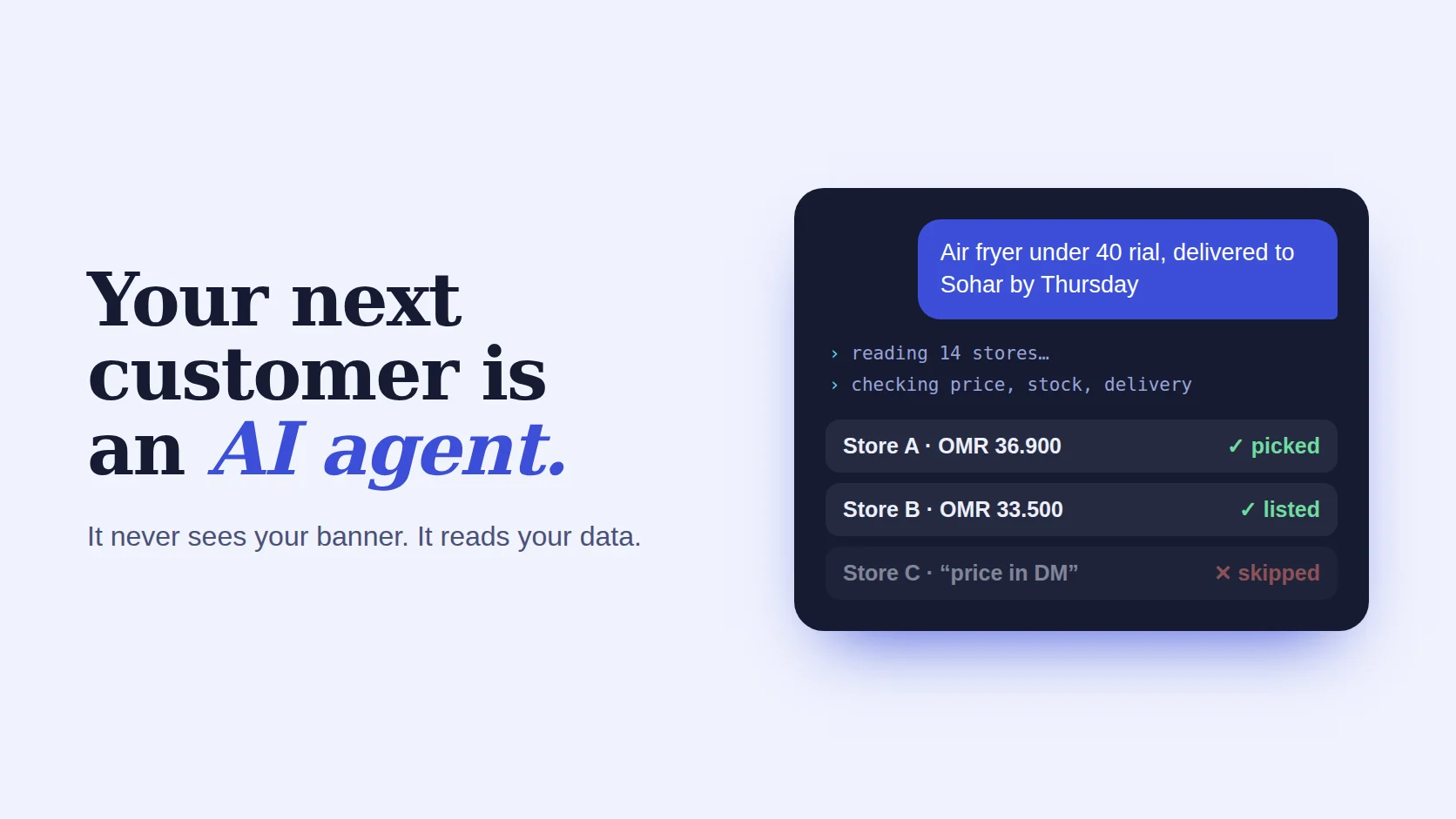
Find me an air fryer under 40 rial, at least 5 litres, that can reach Sohar by Thursday. Good reviews only.
- searching 14 stores…
- reading product pages and delivery policies…
- skipping 6 stores: no price, no stock status or no delivery info
I found three that fit. Store A has the best reviews and delivers to Al Batinah North in 2 days. Store B is 3 rial cheaper but only ships from Muscat on Sundays. Want me to open the checkout for Store A?
That conversation is a composite, but every step in it is already possible. Notice what happened in the middle: six stores were dropped before a human ever saw them. Not because their products were worse, but because the assistant couldn’t find a price, a stock status or a delivery promise it could trust.
For fifteen years, e-commerce marketing has been about persuading people: better photos, better ads, better copy. Those still matter. But a growing slice of shopping now starts with a software agent doing the research, and agents are persuaded by different things: clear, complete, consistent, machine-readable facts.
What “agentic commerce” actually means
An AI agent is an assistant that doesn’t just answer, but acts: it searches, compares, fills in forms and, increasingly, pays. In shopping, it helps to think in three stages:
Discover
“What are good options for…?” ChatGPT, Gemini, Perplexity, Claude and Google’s AI Mode already build shortlists from the open web.
Decide
Agents compare price, specs, delivery and reviews side by side, and explain their pick. Your data either survives that comparison or doesn’t.
Buy
Checkout inside the assistant, or an agent paying on the customer’s behalf. Launched first in the US; coming to other markets over time.
For most businesses in Oman, the first two stages are the urgent part. Even where in-chat checkout isn’t available yet, agents already decide which stores a customer hears about.
How fast this has moved
- Late 2024Perplexity starts letting some US users buy products directly from its answers.
- April 2025Visa and Mastercard announce programmes that let AI agents pay with tokenised cards on a user’s behalf.
- September 2025OpenAI launches Instant Checkout in ChatGPT and open-sources the Agentic Commerce Protocol with Stripe. Google publishes AP2, a protocol for agent payments.
- November 2025Google adds agentic checkout to AI Mode and Gemini in the US, plus AI calling local stores to check stock.
- 2026Platforms including Shopify connect merchants to these protocols, and assistants roll shopping features out to more countries.
Details and availability change quickly. Check each platform’s current documentation for what is live in Oman.
What an agent sees on your store
A human visitor sees a beautiful product photo with “Only 3 left! Free delivery in Muscat” written across it in a graphic. An agent sees an image it may not read, and a page with no stock or delivery information in text. Here is the difference:
| Detail | Hard for agents | Easy for agents |
|---|---|---|
| Price | “Price in DM”, or only inside an image | Price in page text and in Product structured data, in OMR |
| Stock | “Ask us on WhatsApp” | In stock / out of stock in text and in data |
| Delivery | “Fast delivery across Oman” | “Muscat 1 day, Sohar and Nizwa 2 days, Salalah 3 days, OMR 2” |
| Returns | No page, or a vague one | A clear return window and conditions, linked from each product |
| Specs | Specs only in a photo or a video | Size, capacity, material, model number and warranty as text |
| Reviews | Screenshots of WhatsApp messages | Verified reviews on the page and on your Google listing |
This matters especially in Oman, where many successful brands sell mainly through Instagram and WhatsApp. That works brilliantly for people who already follow you. It is almost invisible to an agent. You don’t need to abandon social selling, but you need a readable home base: a simple website with real product pages. See also WhatsApp commerce in Oman and why “price in DM” costs you customers.
The agent-ready checklist
1. Put the facts in structured data
Structured data is a small block of code that states your product facts in a standard format. Google has used it for years for rich results, and AI systems rely on the same signals. Most e-commerce platforms can add it automatically; check that it is complete. A trimmed example:
{
  "@type": "Product",
  "name": "Digital Air Fryer 5.5 L",
  "gtin13": "0000000000000",
  "offers": {
    "@type": "Offer",
    "price": "36.900",
    "priceCurrency": "OMR",
    "availability": "https://schema.org/InStock",
    "shippingDetails": { … delivery time and cost per region … },
    "hasMerchantReturnPolicy": { … 14-day returns … }
  },
  "aggregateRating": { "ratingValue": "4.7", "reviewCount": "212" }
}
2. Keep a clean product feed
A Google Merchant Center feed with correct titles, prices, stock, GTINs and images is one of the main sources Google’s shopping and AI experiences draw from. The same discipline, one accurate list of products, also prepares you for other assistants’ merchant programmes as they open to more countries.
3. Don’t accidentally block the assistants
Many sites copied a robots.txt rule to block “AI bots” without realising there are two kinds: bots that collect training data, and bots that fetch pages to answer a customer’s question right now. Blocking the second kind removes you from the answer. The main user agents to know:
- OpenAI:
GPTBot(training),OAI-SearchBot(search results in ChatGPT),ChatGPT-User(fetching a page a user asked about). - Anthropic:
ClaudeBot(training),Claude-SearchBot(search),Claude-User(user requests). - Perplexity:
PerplexityBot(indexing) andPerplexity-User(user requests). - Google:
Googlebotpowers Search and AI Overviews.Google-Extendedcontrols use in Gemini models, not your Search ranking.
Whether to allow training is your business decision. Blocking the search and user bots, for a store that wants customers, usually isn’t.
4. Write for the question, not the keyword
Customers ask agents full questions: “Which one is quieter?”, “Does it fit a small kitchen?”, “Is the warranty valid in Oman?”. Product pages that answer those in plain text, with a short FAQ, give the agent something to quote. That is the same work described in the AI search visibility guide.
5. Make your reputation checkable
Agents look for evidence beyond your own site: Google reviews, marketplace ratings, local news, forum mentions. A consistent business name, address and phone number everywhere, and recent reviews with replies, make you easier to trust. See Google reviews in Oman.
6. Make checkout robot-proof and human-friendly
Guest checkout, clear totals including delivery and VAT, local payment options and no surprise fees help humans and agents alike. A checkout that needs an account, a CAPTCHA and a WhatsApp confirmation will lose the agent and many people too.
How readable is your store?
Tick what is true today. Be honest; the score is for you.
Runs in your browser; nothing is saved. Weights are my judgement of impact today, not an official standard.
How to see if agents are sending you customers
You can already measure the early signal. In GA4, open Reports → Acquisition → Traffic acquisition and add a filter for session source containing chatgpt, perplexity, gemini, copilot or claude. ChatGPT adds utm_source=chatgpt.com to many of the links it shows, which makes it easier to spot.
The numbers will probably be small today. Watch the trend and, more importantly, the conversion rate: visitors who arrive after an assistant has already compared options often buy faster. The AI search clicks and leads guide covers the setup in more detail.
What this doesn’t change
Agents still recommend stores that are good. A fast delivery promise you keep, fair prices, a product people love and a team that answers are still the whole game. Agentic commerce doesn’t replace marketing; it removes the places where weak information could hide behind strong visuals.
The encouraging part for smaller Omani stores: agents don’t care about ad budgets. A shop in Nizwa with complete, honest data can be recommended ahead of a much bigger brand with a glossy, unreadable site.
Common questions
Can customers in Oman buy inside ChatGPT or Gemini today?
In-chat checkout launched in the US first and is expanding gradually. Even where it isn’t available, assistants already research and recommend stores for Omani shoppers, so the readiness work pays off now.
Do I need a big e-commerce platform for this?
No. Shopify, WooCommerce, Salla, Zid and similar platforms can output product data. What matters is that every product has a complete, accurate page.
Should I add an llms.txt file?
It is harmless and quick, but there is little evidence that major assistants rely on it yet. Structured data, a clean feed and readable pages matter far more.
Will agents make brand loyalty disappear?
No, but they reward brands people ask for by name. A customer who says “order my usual from…” skips the comparison entirely. See why branded demand matters.
Sources & documentation
Checked September 26, 2026. Features and country availability change often.
- OpenAI: Buy it in ChatGPT — Instant Checkout and the Agentic Commerce Protocol.
- OpenAI crawler documentation — GPTBot, OAI-SearchBot and ChatGPT-User.
- Google Search Central: Product structured data — required and recommended properties.
- Google common crawlers — Googlebot and Google-Extended.
- Schema.org: MerchantReturnPolicy — return policy markup.