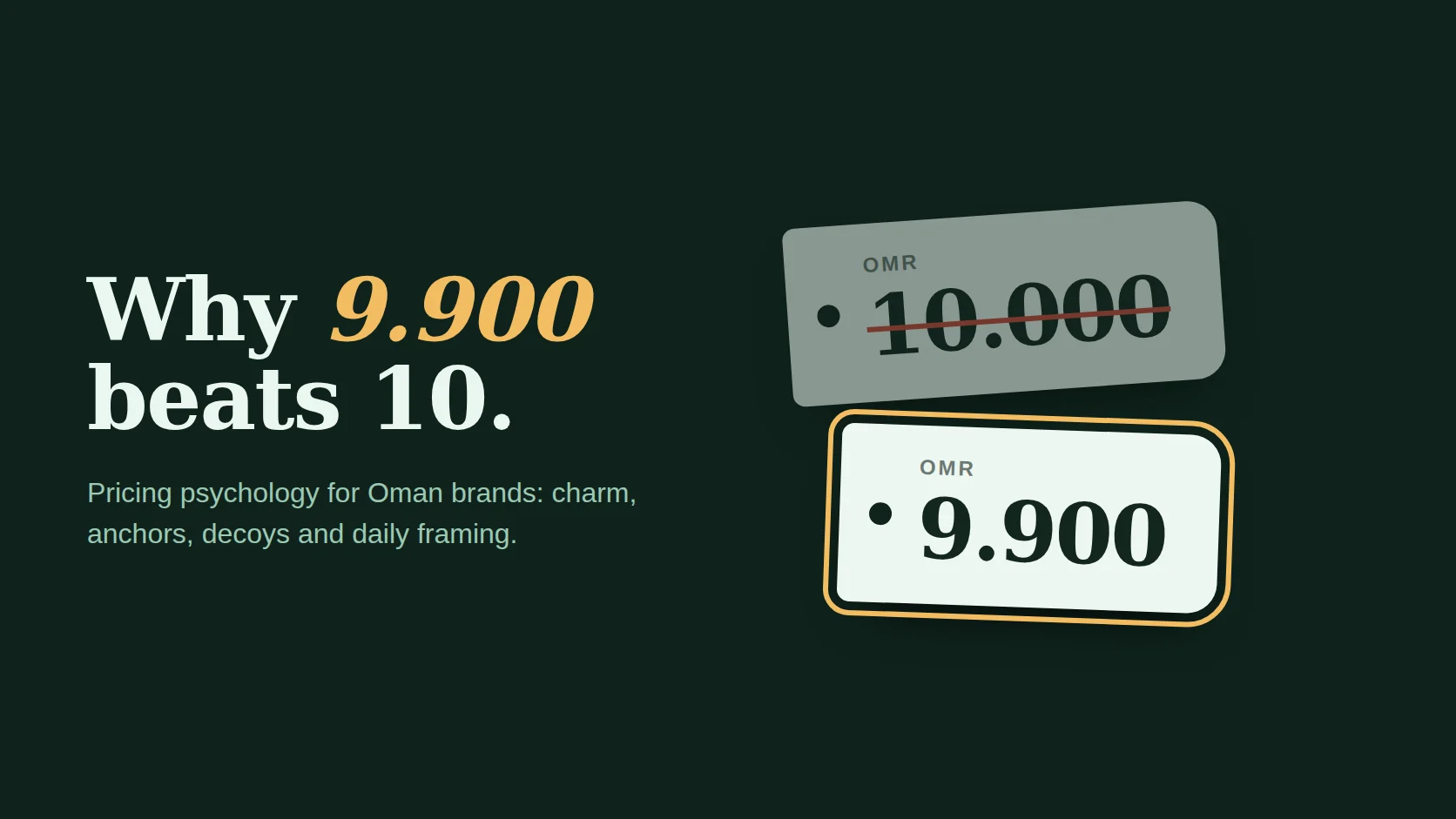
Two perfume sellers in the same Muscat mall stock the same bottle. One prices it at OMR 10.000. The other prices it at OMR 9.900, shows the larger bottle next to it at OMR 16.500, and adds a small line: “about 330 baisa a day for a month of wear.”
Same bottle. Same margin, almost. Very different conversations at the counter.
Most businesses set prices with a calculator: cost, plus margin, rounded. That gets you a number. It doesn’t tell you how customers will read that number. Decades of consumer research show people don’t process prices like accountants. They skim, compare, anchor on the first figure they see and judge “expensive” relative to whatever sits next to it. The perfume example is a composite teaching scenario, not a specific business.
Oman has an unusual advantage here. With 1,000 baisa to the rial and prices written to three decimals, you have more room to shape a price ending than most currencies allow. Used well, that is a quiet lever on sales. Used cynically, it damages trust. This guide is about the first.
1. People read prices left to right, and stop early
The best-known effect is the left-digit effect. When we see 9.900, the first digit, 9, does most of the work before our brain registers the rest. Researchers Manoj Thomas and Vicki Morwitz showed that a price like 2.99 is judged meaningfully lower than 3.00, far more than the one-cent difference justifies, and only when the leftmost digit changes. 4.99 against 4.60 doesn’t get the same boost, because the first digit is already 4.
In practice: dropping from 10.000 to 9.900 changes the left digit and changes perception. Dropping from 9.900 to 9.500 costs you 400 baisa and barely changes how cheap it feels. If you are going to use a charm ending, put it just under a round number, where the left digit flips.
2. But charm prices can cheapen a premium brand
Charm endings signal “deal”. That is great for groceries, fast fashion, electronics accessories and everyday services. It is wrong for things people buy with feelings: a wedding photographer, a fine-dining tasting menu, a luxury abaya, a gift.
Research by Monica Wadhwa and Kuangjie Zhang found that round prices “feel right” for emotional, hedonic purchases, while precise prices fit rational, cognitive ones. A photographer charging OMR 350 sounds like a professional. OMR 349.900 sounds like a discount shop. Match the ending to what the customer is feeling, not only to what they are paying.
Everyday & comparison buys
Groceries, phone accessories, delivery apps, gym day passes, anything shoppers compare side by side. Try 4.900, 9.900, 19.900.
Premium & emotional buys
Weddings, beauty treatments, fine dining, luxury gifts, design and consulting retainers. Try 25, 150, 1,200.
Negotiated & B2B quotes
A quote of OMR 4,870 signals it was costed; OMR 5,000 invites a counter-offer. Precise first offers tend to anchor negotiations more firmly.
One system per brand
Mixing 9.900, 12.450 and 18 on the same menu looks careless. Pick one ending style and apply it everywhere.
3. The first number sets the scale
Anchoring, first documented by Amos Tversky and Daniel Kahneman, means the first number we see pulls our later judgements towards it. On a price page, the first price a visitor sees becomes the ruler every other price is measured against.
That is why many service businesses show their largest package first. After seeing a OMR 1,200 “complete launch” package, a OMR 450 “starter” package feels approachable. Show the OMR 450 first, and the OMR 1,200 feels like a jump. The prices didn’t change. The ruler did.
Keep anchors real. A “was OMR 30, now OMR 15” tag only works legally and ethically if the product genuinely sold at OMR 30. Invented reference prices can breach consumer protection rules and are exactly the kind of thing that ends up screenshotted in a family WhatsApp group. See why hiding prices costs you customers, too.
4. The decoy that sells the middle option
In his book Predictably Irrational, Dan Ariely described an old subscription offer from The Economist: web only for $59, print only for $125, or print and web for $125. Almost nobody wants “print only” at the same price as print-and-web, but its presence made the bundle look like a steal. When it was removed, far more people chose the cheap web-only option.
This is the decoy effect, first described by Joel Huber, John Payne and Christopher Puto in 1982. A clearly worse option placed next to your target makes the target look like the smart choice. Here is how a Muscat training centre might use it:
Online course
OMR 45Recorded lessons, certificate.
Classroom only
OMR 90Eight evening sessions in Al Khuwair.
Classroom + online
OMR 90Eight sessions, plus every recording and the certificate.
The decoy exists to make the comparison easy. It should still be a real, honest option you would deliver.
5. Shrink the unit, not the price
A OMR 120 yearly membership sounds like a decision. “Less than 330 baisa a day” sounds like a coffee. John Gourville called this the pennies-a-day effect: re-expressing a larger sum as a small daily amount makes people compare it with small everyday spending instead of with other big purchases.
It works best for subscriptions, memberships, insurance, software and courses, where the value is spread over time anyway. It works badly for one-off purchases, where it can feel like a trick. Use it next to the full price, never instead of it.
6. How the price looks matters too
- Drop the clutter on menus. A small Cornell study of restaurant menus found diners spent more when prices were shown as plain numbers, without a currency sign or the word “dollars”. For a café in Oman that already states “all prices in OMR” once, 4.5 reads softer than OMR 4.500.
- Smaller can feel cheaper. Research by Keith and Robin Coulter suggests a sale price shown in a smaller font can feel like a bigger saving, because size and magnitude get mixed up in our heads.
- Keep Arabic and English prices identical. If the Arabic menu says ٩٫٩٠٠ and the English one says 10, customers notice, and they don’t assume it was an accident.
- Set free delivery just above your average order. If a typical basket is OMR 18, a free delivery line at OMR 20 or 25 nudges people to add one more item. At OMR 50 it is out of reach and ignored.
Try your own price
Enter a price and what kind of purchase it is. The lab suggests charm and round versions, a daily framing and a three-option ladder.
Runs in your browser; nothing is saved. Suggestions are starting points to test, not guaranteed winners.
Test it, don’t guess it
Every effect above is real on average and uncertain for your business. The only reliable answer is a test. Some simple ways to run one in Oman:
- Online stores: change the price ending on half your catalogue for four weeks and compare conversion rate and revenue per visitor, not just units sold.
- Ads: run two ad versions with different price framing (OMR 120/year vs “under 330 baisa a day”) and compare cost per lead, then check which leads actually pay.
- Service businesses: reorder your packages on the quote PDF for a month and track which package people choose.
- Cafés and restaurants: test a menu change across two similar weeks, avoiding Ramadan, Eid and school holidays in the comparison.
Watch profit, not only volume. A cheaper-looking price that sells 10% more at 15% less margin is a loss. The discount profit test walks through that maths.
The Oman price page checklist
- Every product or package shows a price, or a clear “from” price.
- One ending style across the brand: charm for everyday, round for premium.
- Charm endings sit just below a round number, where the left digit changes.
- The option you want to sell has a clearly worse neighbour and a clearly bigger one.
- Subscriptions show a daily or monthly equivalent next to the full price.
- “Was” prices are genuine and recent.
- Arabic and English prices match exactly, including VAT treatment.
- The free delivery threshold sits 10–40% above your average order value.
Common questions
Does 9.900 still work if everyone uses it?
Mostly yes, because the left-digit effect is about how we read, not about novelty. But in a market full of charm prices, a confident round price can also stand out as premium.
Should I show prices with or without VAT?
For consumers, show the final price they will pay. Surprise additions at checkout are one of the most common reasons people abandon a purchase.
Is the decoy effect manipulative?
It becomes manipulative when the options are fake or the comparison is misleading. If every option is real and fairly priced, you are simply making the choice easier to understand.
What about prices ending in 5, like 9.950?
They work similarly to 9.900 because the left digit still flips. Pick whichever looks cleaner on your menu or site and use it consistently.
Research & sources
Checked September 26, 2026. Findings come from studies in other markets; test them with your own customers.
- Thomas, M. & Morwitz, V. (2005). “Penny Wise and Pound Foolish: The Left-Digit Effect in Price Cognition.” Journal of Consumer Research, 32(1).
- Wadhwa, M. & Zhang, K. (2015). “This Number Just Feels Right: The Impact of Roundedness of Price Numbers on Product Evaluations.” Journal of Consumer Research, 41(5).
- Tversky, A. & Kahneman, D. (1974). “Judgment under Uncertainty: Heuristics and Biases.” Science, 185(4157).
- Huber, J., Payne, J. & Puto, C. (1982). “Adding Asymmetrically Dominated Alternatives.” Journal of Consumer Research, 9(1).
- Ariely, D. (2008). Predictably Irrational. HarperCollins.
- Mason, M., Lee, A., Wiley, E. & Ames, D. (2013). “Precise Offers Are Potent Anchors.” Journal of Experimental Social Psychology, 49(4).
- Gourville, J. (1998). “Pennies-a-Day: The Effect of Temporal Reframing on Transaction Evaluation.” Journal of Consumer Research, 24(4).
- Yang, S., Kimes, S. & Sessarego, M. (2009). “Menu Price Presentation Influences on Consumer Purchase Behavior in Restaurants.” Cornell Center for Hospitality Research.
- Coulter, K. & Coulter, R. (2005). “Size Does Matter: The Effects of Magnitude Representation Congruency on Price Perceptions and Purchase Likelihood.” Journal of Consumer Psychology, 15(1).