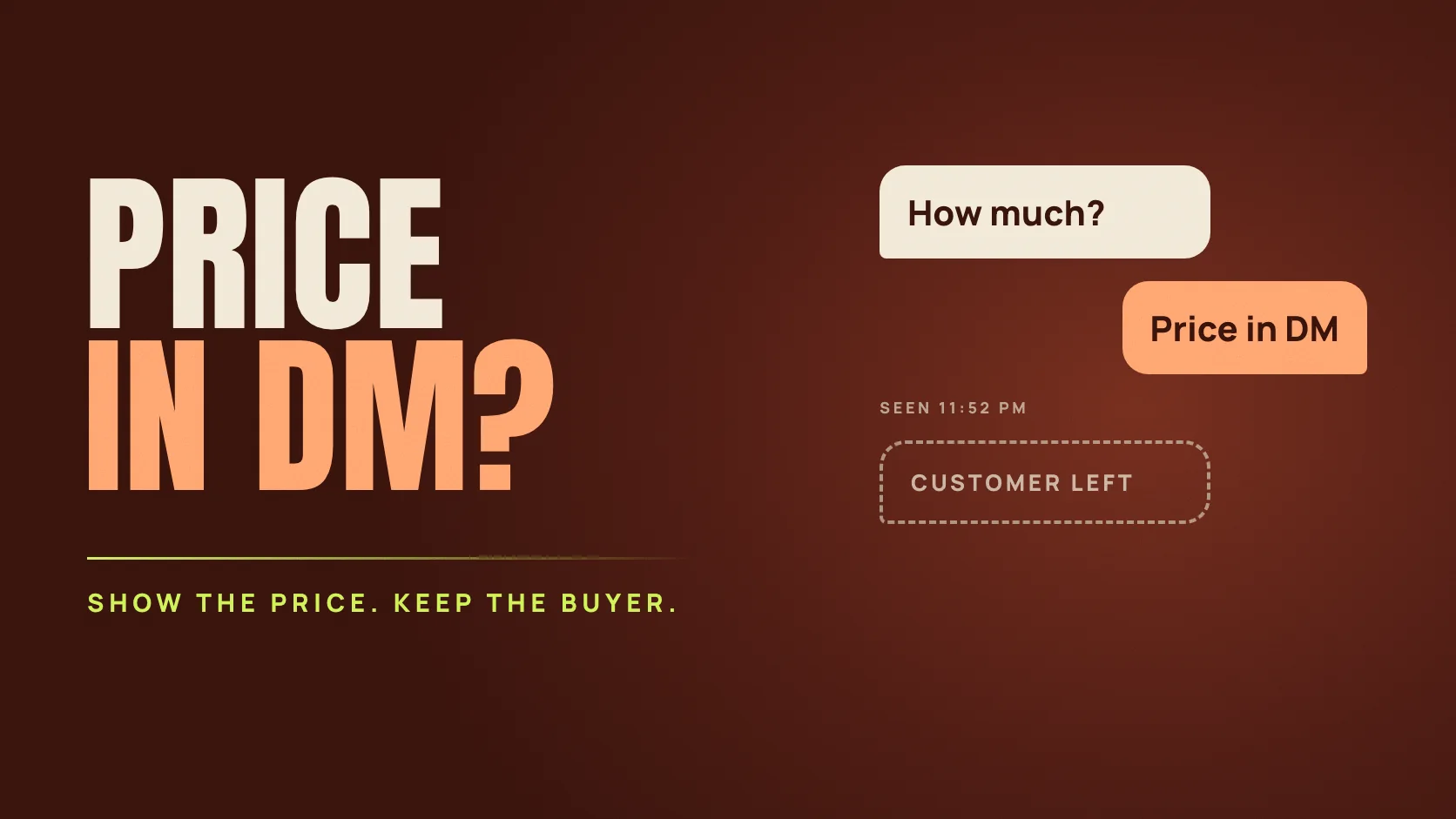
“How much?”
“Price in DM 🙏”
Scroll. Gone.
Picture a home-furniture shop in Muscat with a beautiful Instagram grid. Every post ends the same way: “Price in DM.” The team answers about 120 price questions a week. Most conversations stop right after the number is sent. The owner concludes that Instagram brings “time-wasters.”
But the inbox only shows people who asked. It cannot show the people who liked the sofa, wondered whether it was OMR 200 or OMR 2,000, and moved on without typing. Nor does it show the regular customer who asked at midnight, got a reply the next afternoon, and had already bought elsewhere.
This is a fictional teaching example, not a client case study. The pattern is common across social selling in the Gulf, and it is worth questioning with numbers rather than habit.
The four reasons behind “price in DM”, and what each misses
Hidden prices are rarely lazy. They usually come from a real worry. The problem is that each worry has a better answer than silence.
| The reason | What it misses | A better answer |
|---|---|---|
| “Competitors will copy our price.” | Competitors can ask in a DM too. Only customers are really kept in the dark. | Compete on what is included, not on secrecy. |
| “The price depends on the order.” | Customers still need a starting point to judge whether to ask. | Show a “from” price or a typical range. |
| “The DM starts a conversation.” | It starts one with some buyers and ends it for others before it begins. | Invite questions about size, delivery and options instead. |
| “A number looks expensive on its own.” | Silence often looks more expensive than the real number. | Show the price beside what justifies it. |
What a hidden price really costs
The cost has three parts, and only one of them is visible in your inbox.
Staff time. Every price question needs a reply, often a follow-up, and sometimes a photo or two. Multiply a few minutes by hundreds of questions a month and the number is real, even for a small team.
Response delay. A customer who asks at 11 pm and gets an answer at 2 pm the next day has had fifteen hours to buy elsewhere. A price on the post answers instantly, at any hour. For the operating side of replying well, see the lead response system guide.
The customers who never ask. Some people will not message a business just to learn a price. They may be shy, busy, browsing at work, or simply unwilling to be followed up. You cannot count them in your inbox, which is exactly why they are easy to ignore.
The split is invented. Your real split is unknown, and that is the problem: a hidden price makes the largest group of interested people impossible to see or measure.
How much time do price questions take?
Count one normal week of messages that mainly ask for a price. Include the minutes spent on follow-ups and photos, not just the first reply.
That is 34.7 hours a month spent answering a question a visible price or price range could answer before anyone types.
Calculations run in your browser; nothing is sent or saved. The calculator counts only visible work. It cannot count the customers who never asked.
Look again at the last number. In this example, 312 conversations a month end the moment the price arrives. Many of those people were not time-wasters. They were buyers for whom the price did not fit, and they would have happily skipped the conversation if the price had been on the post.
What Oman’s consumer rules say about showing prices
Oman’s Consumer Protection Law and its Executive Regulation set clear expectations for price display. As summarised by the Times of Oman in June 2026, suppliers must show the selling price clearly on the product, its packaging or container, with Arabic as the required language, and restaurants, cafés and similar businesses must display a price list inclusive of applicable tax. Suppliers may not charge more than the announced or advertised price. [1] [2]
Those provisions are written with physical goods and premises in mind, and how they apply to a social media listing is a question for the Consumer Protection Authority, not a blog. [3] But the direction is plain: Oman expects prices to be clear before a sale, and a price published on a post also protects you, because it is on record when a customer later disputes what they were told.
Five better ways to show price without losing flexibility
Exact prices for standard items
If the product has one price, put it in the caption, on the image and in your catalogue. This is the simplest and most trusted option.
“From” prices for variants
“From OMR 145, depending on fabric” sets expectations while leaving room for options that change the final figure.
Typical ranges for projects
“Most three-seat sofas: OMR 220–380” helps project buyers judge fit without committing you to a quote.
Packages for services
Name two or three packages with what each includes. Customers compare packages much more easily than open-ended quotes.
The fifth option is to move the conversation to what genuinely needs a conversation. Replace “Price in DM” with a call to action that invites a useful question: “Message us your room size and we’ll suggest the right model.” The price stays public; the expertise becomes the reason to message.
- Before
- New arrivals 😍 Price in DM.
- After
- New three-seat sofa in oak and linen · OMR 285 · free delivery in Muscat · other fabrics from OMR 260. Message us your room size and we’ll check the fit.
Keep the price consistent across Instagram, WhatsApp catalogue, website and Google Business Profile. A different number on each channel creates exactly the doubt the price was meant to remove. The WhatsApp commerce guide covers catalogues in more detail.
Test it for a month before you decide
You do not need to believe this article. You can test it. Pick one product line, publish its price for four weeks, and keep everything else the same.
- Record a baseline. For the four weeks before, note price questions, conversations, orders and staff time for that product line.
- Publish the price. Add it to the caption, image, catalogue and website for that line only, using one of the formats above.
- Change the call to action. Invite questions about fit, delivery or options rather than price.
- Compare like with like. After four weeks, compare orders, conversations and staff hours. Watch for seasonal effects such as salary week, Eid or National Day, and compare with the same period last year if you can.
Before you post the next product
Let the price do the first conversation
A visible price is not a race to the bottom. It is a quiet salesperson that works at midnight, answers everyone at once and never forgets to reply. The DMs that remain are better ones: people who already know the price and want your help.
Questions shop owners ask
Won’t showing prices drive away customers who think we’re expensive?
Some, yes, and they would have left after the DM anyway, only later and after using your team’s time. Showing what is included beside the price helps the right customers see why it is worth it.
What if our prices change often?
Use “from” prices or ranges, date your price lists, and update the catalogue when prices change. Never charge more than the price you have advertised.
Does this apply to service businesses too?
Yes. Packages and typical ranges work well for salons, clinics, contractors and agencies. Customers rarely need an exact quote to decide whether to start a conversation.
References & method
Sources checked September 24, 2026. This article is practical guidance, not legal advice; confirm how the rules apply to your business with the Consumer Protection Authority. The furniture shop and all figures are fictional.
- Times of Oman: How Oman’s Consumer Protection Law regulates price display — summary of price-display duties and penalties (June 2026).
- Royal Decree 66/2014: Consumer Protection Law — the law itself.
- Gov.om: Consumer Protection Authority — the authority responsible for applying the rules.
Method: monthly questions = weekly questions × 52 ÷ 12. Staff hours = monthly questions × minutes per conversation ÷ 60. Staff cost = hours × hourly cost. Chats that end at the price = monthly questions × silent share.