


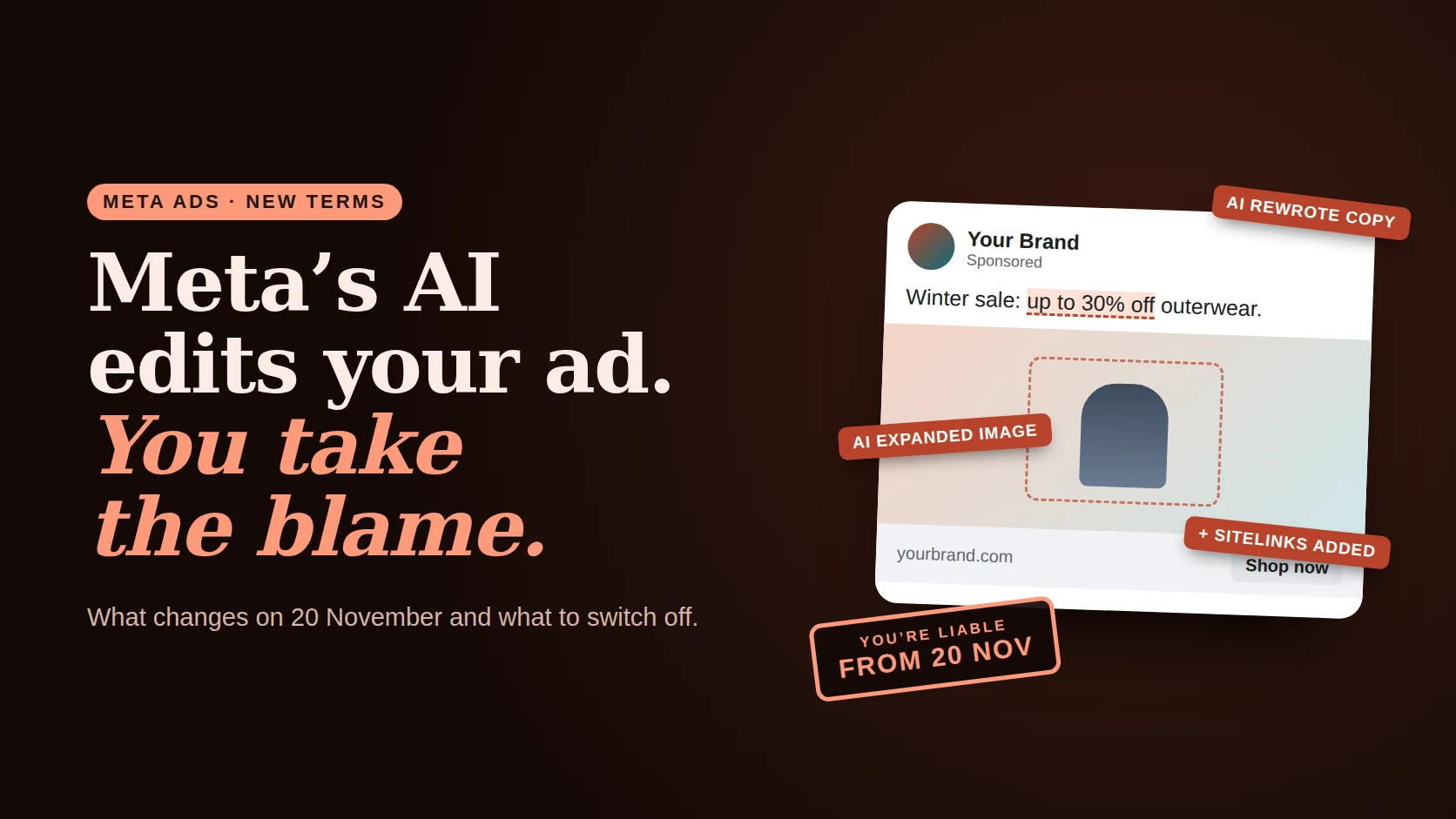
- Meta’s revised terms add an AI Features section making advertisers “solely responsible” for what Meta’s AI creates or changes in their ads.
- Under the old wording you were responsible only for AI tools you chose to use. The new section drops that condition.
- The terms were due on 30 October. After complaints to EU and UK competition regulators, Meta moved them to 20 November 2026.
- You cannot opt out of the terms, but you can switch off individual Advantage+ creative features. Do it, and keep proof of what you approved.
Checked 24 October 2026. Meta’s revised terms are published as previews and summarised here from trade reporting and Meta’s public statements. This is not legal advice. Read the final terms in your Business Manager when they are shown, and ask a lawyer if your ads carry regulated claims.
01What the new terms say
On 22 October, Adweek reported a new section in Meta’s revised Commercial Terms called “AI Features”. It makes advertisers “solely responsible” for whatever Meta’s artificial intelligence features create or change in their ads, including features Meta itself turns on.1 It quickly became one of the most discussed stories in paid social.2
| Situation | Current terms | From 20 Nov 2026 |
|---|---|---|
| You choose an AI tool (e.g. generate a background) | You | You |
| Meta switches an AI feature on by default | Unclear; tied to your choice | You, “solely” |
| AI adds text, links or translations you never saw | Unclear | You |
| Ad breaks advertising law because of an AI edit | Disputed | Your risk under the terms |
The timeline moved fast:
Meta’s position is that advertisers stay in control: a spokesperson said advertisers “can turn off individual Advantage+ features in Ads Manager at any time”.3 Critics reply that the terms do not say whether you are still liable for a feature you never enabled, and that there is no opt-out from the terms except stopping advertising on Meta.4
02What Meta’s AI already changes
This is not hypothetical. Advantage+ creative includes a family of “enhancements” that can alter an ad at delivery time, and several are on by default in new campaigns. Agencies have reported ads running with sitelinks, translated copy and AI “glow-ups” they did not request.5
Illustration of the kinds of changes advertisers have reported. Exact enhancements vary by placement, objective and account.
Rewritten headlines and copy
Text variations and “improvements” can produce wording you never wrote. A discount, guarantee or health claim can shift meaning in one edit.
Expanded and retouched images
Image expansion, backgrounds, filters and touch-ups change the product photo. For fashion, beauty and food, that can misrepresent what you sell.
Sitelinks, overlays and music
Links to other pages, text overlays, product tags and added music can send people to places, or attach claims, you did not plan.
Automatic translation
Translated ads reach new audiences in words nobody on your team checked. In regulated sectors, that is the riskiest edit of all.
03The website-crawling clause
The same update consolidates terms that let Meta access, index, cache, analyse and crawl websites associated with business accounts, and pull updates periodically.6 Before the delay, Meta removed a sentence saying crawled content could be used to train its products, and limited the purpose to advertising, business products, and integrity and security. Meta says the clause applies only to its ads and business products.
Two things are still worth knowing:
- The terms do not mention robots.txt.
- Meta’s Meta-ExternalAgent crawler uses a single robots.txt token for both indexing and AI training, so you cannot easily allow one and block the other.7
For most advertisers, this changes little day to day: Meta already reads your landing pages to review ads and build catalogues. Publishers who sell their content are the ones pushing back hardest.
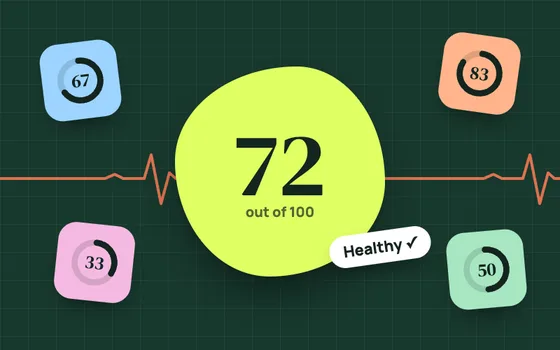
How exposed are your Meta ads to AI edits?
Tick what applies to your account today. The check scores your exposure and lists what to switch off first.
Runs in your browser; nothing is saved. A guide to priorities, not legal advice.
04The 20-minute audit
Do this once now, then after every new campaign. It works whatever the final terms say.
List what is live
In Ads Manager, filter to active ads and export the list. Start with the ads that spend the most.
Open each ad’s creative settings
At ad level, find Advantage+ creative and review every enhancement. Switch off text changes, translations, image expansion and added links unless you have checked them.
Preview every placement
Use the placement preview for Feed, Stories, Reels and Threads. Screenshot what will actually show.
Keep proof
Save the approved copy, image and settings with a date. If a disputed edit appears later, you can show what you approved.
Set a monthly check
Meta adds and re-enables features over time. Put a monthly calendar reminder to repeat steps 2 and 3, and recheck when the final terms appear.
Automation is not the problem. Unreviewed automation, with your name on it, is.
Related reading: the Meta AI defaults audit and Meta’s Business Agent.
Common questions
When do Meta’s new advertising terms take effect?
Meta’s revised Commercial Terms and Self-Serve Ad Terms are due to take effect on 20 November 2026. They were originally set for 30 October 2026 and were delayed after publishers and advertisers complained to EU and UK competition authorities.
Are advertisers responsible for Meta’s AI edits to their ads?
Under the revised terms, reported by Adweek on 22 October 2026, advertisers are “solely responsible” for whatever Meta’s AI features create or change in their ads, including features Meta switches on by default. The earlier wording tied responsibility to AI tools the advertiser chose to use.
Can I opt out of Meta’s AI creative features?
You cannot opt out of the terms, but Meta says advertisers can turn off individual Advantage+ creative features in Ads Manager at any time. Review each ad’s creative enhancements and switch off the ones you have not checked.
Can Meta crawl my website under the new terms?
The revised terms let Meta access, index and crawl websites associated with business accounts, for advertising, business products, and integrity and security. Meta removed a sentence about using crawled content to train its products, but the terms do not mention robots.txt.
Method & sources
Checked October 24, 2026. Meta has not published a full public explanation of the AI Features section; this summary relies on trade reporting and Meta’s statements to the press. Dates may change again.
- Relevant Audience, “Meta AI Features terms: advertisers liable from 30 Oct”, citing Adweek. relevantaudience.com
- PPC Land, “Meta makes advertisers solely responsible for its AI ad edits from Oct 30” and “Meta delays its AI terms to November 20”. ppc.land · ppc.land
- FashionNetwork, “Meta postpones its new business terms following criticism from advertisers”. fashionnetwork.com
- Unite.AI, “Meta delays Commercial Terms update as publishers demand withdrawal”. unite.ai
- Adweek, “Advertisers pull Meta ads that had unwanted AI glow-ups”. adweek.com
- Unite.AI, “Meta rewrites web-crawling clause in pending Commercial Terms”. unite.ai
- Search Engine Journal, “Meta’s new terms expand crawling rights beyond advertisers”. searchenginejournal.com