


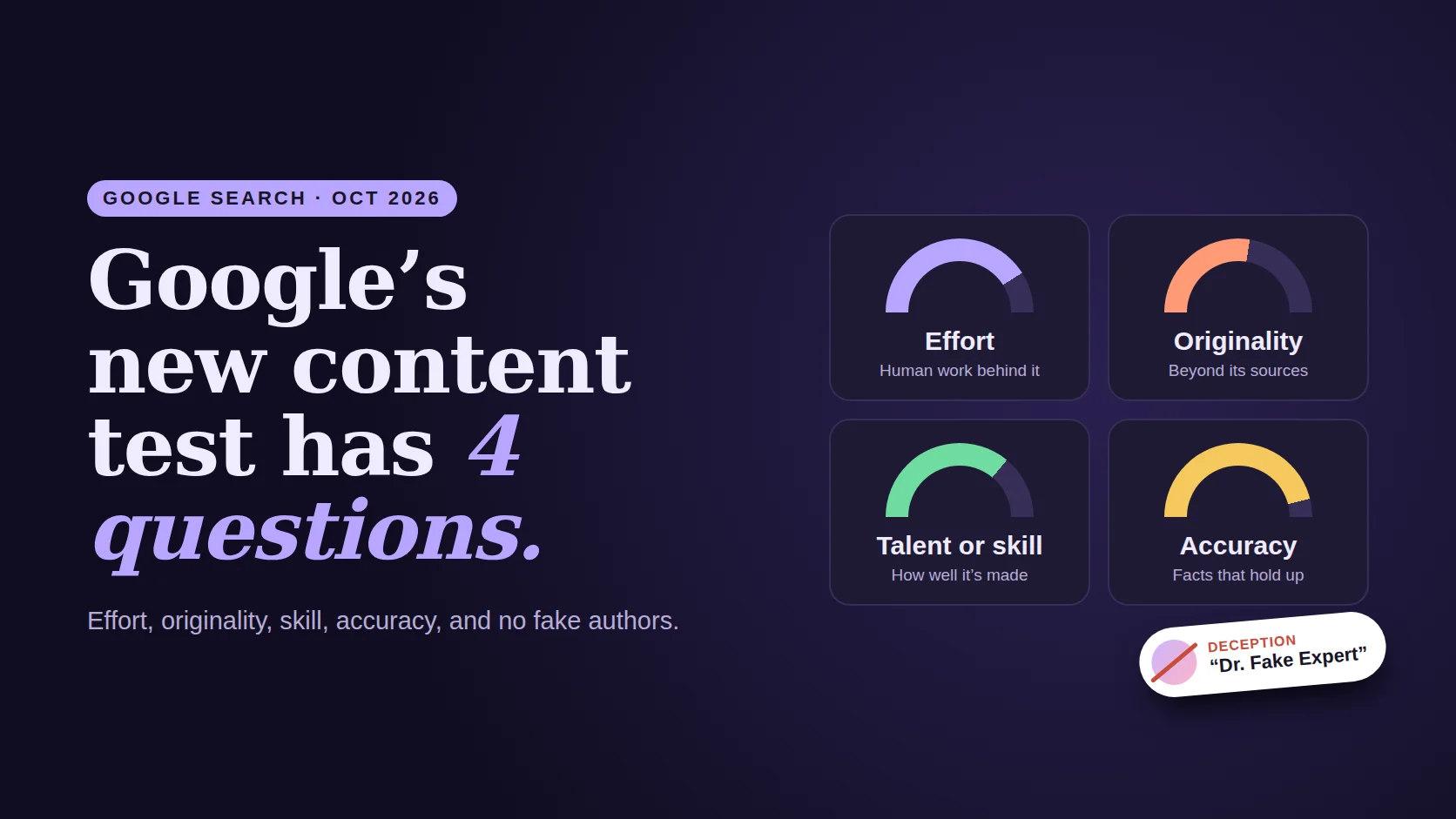
- Google now defines main content as any part of a page that directly helps it achieve its purpose, including tools, reviews, tabs and headings.
- Quality raters judge four things: effort, originality, talent or skill, and accuracy, with a higher accuracy bar for topics that affect health, money or safety.
- Fake authors (AI headshots, invented names, false credentials) are now named as deception.
- AI use is not banned. Mass-produced AI text without human oversight is Google’s example of low effort.
Checked 24 October 2026. Reports give 1, 2 or 5 October for the change; the page itself shows 1 October. Rater attributes are not ranking signals by themselves: raters help Google test its systems. But they describe what those systems are built to reward.
01What changed
Google’s “Creating helpful, reliable, people-first content” page has been the main reference for content quality since 2022. The October 2026 rewrite does not announce a new algorithm. It makes the rules more specific, and in three places sharper.12
| Topic | Before | From October 2026 |
|---|---|---|
| Main content | Mostly meant the article text | Any part that serves the page’s purpose: tools, reviews, tabbed sections, titles, headings |
| Quality attributes | Self-assessment questions | Four named attributes: effort, originality, talent or skill, accuracy |
| Accuracy | Implied in E-E-A-T | Highly accurate and consistent with expert consensus for life-affecting topics |
| Authors | “Who created it” questions | Fabricated creator profiles named as deception |
| Originality | “Add value” | Citing sources does not make a summary original |
It landed in a busy month. Google’s September 2026 spam update rolled out from 24 September to 8 October, the longest spam update of the year, and site owners have been reporting Discover drops and Search Console delays since.3 Google has not confirmed a core update in October; the last one was in May.
02The four attributes
Effort
How much human work went into the content, or into the system that produced it. Original photos, testing, data collection and careful editing all show effort.
Low: AI text at scale, no reviewOriginality
Does the page add substantial value beyond its sources? New data, first-hand experience, analysis or a tool count. A rewritten summary, even with credits, does not.
Low: summaries of other pagesTalent or skill
Is it made with the skill the topic needs: clear writing, good design, real expertise, working code? Skill shows in the result, not in a bio.
Low: generic, error-filled, paddedAccuracy
Are the facts right and current? For health, money, legal and safety topics, content needs to be highly accurate and consistent with established expert consensus.
Low: outdated or invented factsThe new main content definition matters more than it looks. A calculator, comparison table or product review block is judged as part of the page’s quality, not as decoration. A broken or thin tool now pulls the page down; a genuinely useful one lifts it.4
03Fake authors and AI
Google’s guidance now says fabricated creator profiles, such as AI-generated headshots, made-up names or false credentials used to look like human experts, are deception, and that this makes a page untrustworthy to users and to its automated quality systems.5
On AI itself, the line is about oversight, not tools. Google’s example of little effort is using generative AI to create large numbers of texts without manual oversight and curation. AI-assisted content that is fact-checked, reviewed by a person and adds original value is not the target.6
The question is no longer “was AI used?” It is “would anyone notice if this page disappeared?”
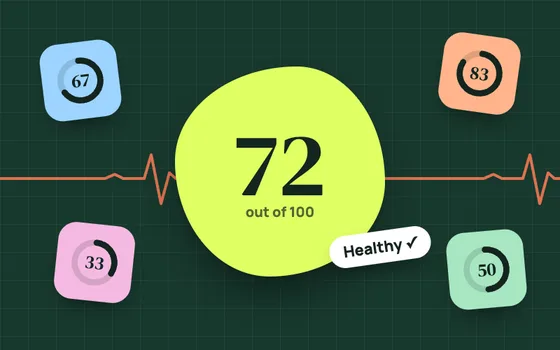
How would your page score on the four attributes?
Pick the closest answer for one page. The scorecard rates each attribute out of 10 and shows the weakest one to fix first.
Runs in your browser; nothing is saved. A self-assessment based on Google’s published guidance, not Google’s own scoring.
04Fixes that move the score
Show your work
Add your own photos, screenshots, test results and the date you checked. Show how the content was made, briefly, near the top.
Add one thing nobody has
A small survey, a local price list, a calculator or a real client example turns a summary into a source others cite.
Edit like it’s print
Cut padding, answer the question early, use tables where readers compare. Make tools work on mobile; they are main content now.
Date and source facts
Link to primary sources, add a “checked on” date and set a review schedule. For health or money topics, get a qualified reviewer.
Real names only
Remove invented personas and stock or AI headshots. Use real people with an about page and links to work people can verify.
Human in the loop
Use AI for drafts and research, then have a person fact-check, add experience and decide what is published. Do not publish at scale unreviewed.
Related: people-first content basics, E-E-A-T in practice and recovering from a core update.
Common questions
What changed in Google’s helpful content guidance in October 2026?
Google’s “Creating helpful content” page, dated 1 October 2026, now defines main content as any part of a page that helps it achieve its purpose, names four attributes quality raters assess (effort, originality, talent or skill, and accuracy), and calls fabricated author profiles deception.
Is AI-generated content against Google’s guidelines?
No. Google’s example of low effort is using generative AI to create large numbers of texts without manual oversight and curation. AI-assisted content that is reviewed, fact-checked and adds original value is not the problem.
Is the October 2026 change a Google ranking update?
No ranking update was announced. It is a documentation change. Rater attributes are used to evaluate Google’s systems, not as direct ranking signals, but they describe what those systems aim to reward.
What does Google mean by fake authors?
Fabricated creator profiles, such as AI-generated headshots, invented names or false credentials used to look like human experts. Google’s guidance calls this deception and says it makes a page untrustworthy.
Method & sources
Checked October 24, 2026. The primary source is Google’s Search Central page; summaries of the new wording were cross-checked across several SEO publications. Quotes are paraphrased where publications differ.
- Google Search Central, “Creating helpful, reliable, people-first content”. developers.google.com
- Relevant Audience, “Google adds fake-author warning to helpful content page”. relevantaudience.com
- Search Engine Watch, “Is a Google October 2026 update rolling out?”. searchenginewatch.com
- DEV Community, “Google elevates main content in helpful content guidance”. dev.to
- PPC Land, “Google says fake author profiles signal a low-quality page”. ppc.land
- Delante, “Google tightens its approach to AI content: what changed in late September and early October 2026?”. delante.co