



Fast is useful. Correct is essential.
Follow a customer conversation from the first question to the human handover, then build a pilot your team can actually operate.
Would you let AI answer this?
Choose a customer message. These examples show a recommended operating policy; they do not simulate Meta's actual product.
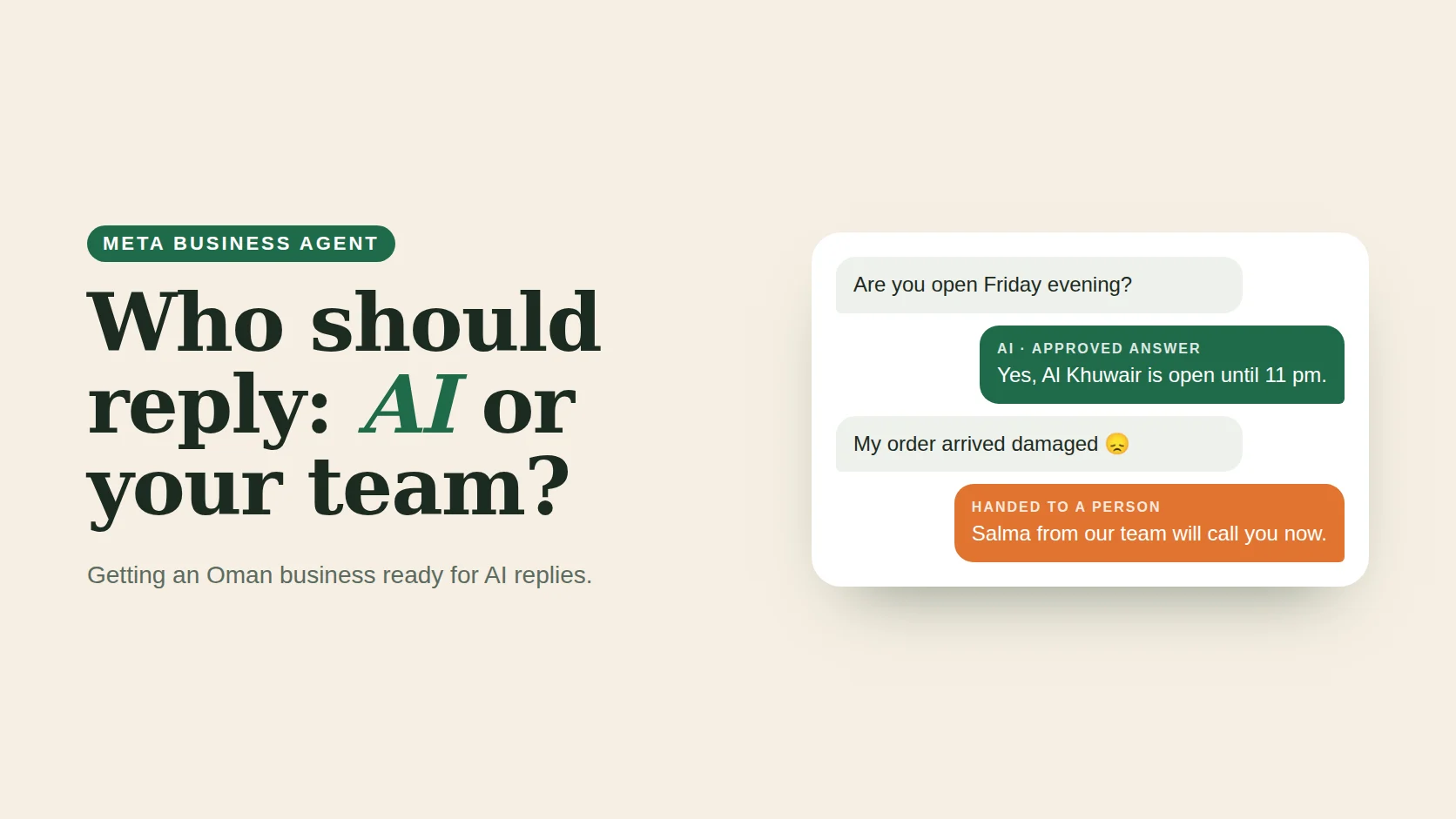
Are you open on Friday evening?
Use the approved branch schedule, mention any known holiday exception, and offer directions.
AI can answer if the opening-hours source is current. Never invent a branch schedule.
A customer asks about availability after closing time. An instant reply is valuable only if it gives a dependable answer. For Oman businesses selling through Instagram and WhatsApp, the preparation behind an AI assistant matters as much as the speed of the response.
What changed in 2026?
Meta introduced Business Agent in June 2026, describing business-specific answers, catalogue recommendations, appointment booking, lead qualification and human handover. It also announced expansion to Instagram and a platform for businesses building more customised agents. These are announced capabilities, not a guarantee that every feature is enabled for your Oman account.
Availability check: Before promising an AI service to customers, verify access, supported channels and languages, integrations and current charges inside your business account. Meta's launch announcement describes an expanding rollout; it does not establish your account's eligibility or today's pricing.
The real starting point is your answer library
Collect the questions staff answer repeatedly: opening hours, branch locations, delivery areas, product dimensions, installation, booking steps and order updates. Give every answer an owner and a review date. If two employees provide different answers today, automation will not resolve the underlying disagreement.
Start with information that changes slowly. A furniture shop can usually explain materials and showroom directions with less risk than confirming stock for a specific finish. Live stock and appointment promises need a reliable connected source. Without one, the reply should explain that a team member must confirm.
Design the handover before the greeting
Write a simple rule for when a person takes over. Complaints, payment disputes, custom quotations, contradictory information and explicit requests for staff should reach a named queue. A handover should retain the customer's question and the answers already given so the person does not have to start again.
An illustrative reply for a Muscat showroom might read: “I can explain the available ranges. A team member will confirm today's stock and installation quote during opening hours.” That is more useful than a confident delivery promise the business cannot fulfil. Put actual response hours into your own version.
Test Arabic and English as separate conversations
Translate the meaning, then test real wording. Customers use short messages, mixed languages, product nicknames and voice-led follow-ups. Ask a bilingual staff member to check whether the answer sounds natural and whether the customer can complete the next step. Do not judge language quality from a single polished demonstration.
- Ask for an item that is unavailable.
- Ask a question whose answer is missing from the business information.
- Change the requested branch halfway through a conversation.
- Request a person and verify that the handover happens.
- Ask about a price or appointment that requires confirmation.
Start with a narrow pilot
Choose one channel and a small set of repeatable questions. Have staff review conversations during the pilot and record wrong answers, unnecessary handovers and missed buying opportunities. Expand only after the team can explain how errors are corrected and who maintains the source information.
Measure correct resolution, qualified enquiries and customer effort alongside response speed. A fast answer followed by three corrections can create more work than the original enquiry. Keep personal information limited to what the task requires and use appropriate account access for staff.
Follow one conversation all the way through
Picture an independent furniture shop in Muscat. A customer sends a photo of a dining table and asks whether a similar finish is available for delivery this week. The question combines product matching, live availability and a delivery promise. Treating it as one simple FAQ is how an instant reply becomes an expensive misunderstanding.
Confirm the product or range. Ask one useful clarifying question if the photo is ambiguous.
Describe known materials, dimensions and available catalogue options.
Check live stock and delivery capacity through an approved source or a staff member.
Make the promise only after verification. Give the customer one clear next step.
The assistant may be able to handle the explanation while a person verifies the delivery date. That division is useful even when the whole conversation cannot be automated. The goal is fewer repeated questions and better continuity, not the largest possible percentage of conversations handled without staff.
Create a small source of truth
Build a working answer sheet before connecting tools. Each entry should include the question, the approved answer, the source, the owner and the next review date. Separate stable facts from live facts. Branch directions change infrequently; stock, delivery slots and promotional pricing may change throughout the day.
Explain confidently
Materials, dimensions, branch directions and standard booking steps, using reviewed business information.
Check before promising
Today's price, stock, installation capacity and appointment availability need a current source.
Give staff ownership
Disputes, refunds, unusual exceptions and requests for a human need an explicit route to the responsible team.
Include an expiry rule. If an offer has ended or an answer has not been reviewed, the assistant should not continue presenting it as current. Assign a person to review changes whenever a new catalogue, campaign or branch schedule goes live. A weekly review alone will not catch an offer that changes tomorrow.
Write the escalation message now
A usable handover message
“I need a team member to confirm that detail. I’ll pass on your question and the product you asked about. Our team replies during [your actual staffed hours].”
Replace the bracketed text before using it. Do not give a precise response-time promise unless your team can consistently meet it.
The internal handover should contain a short summary, the question still unanswered and any relevant order reference already supplied by the customer. Avoid asking for the same information twice. Do not request identity documents or payment-card details merely to answer a routine product question.
A two-week pilot with a clear stop condition
Use the first few days to test a small collection of common questions with staff. Then, if the account supports the required setup, introduce a narrow customer-facing pilot with active human supervision. Keep a log of correct answers, wrong answers, unnecessary questions and successful handovers. Review examples rather than relying only on an average response-time chart.
Agree on stop conditions before launch. An invented price, a false delivery guarantee or a handover that never reaches staff should trigger an immediate review of the affected flow. Restrict or pause that flow until the source or integration is corrected. A confident answer is not evidence of a reliable system.
At the end of the pilot, compare the effort required per resolved enquiry and the quality of customer outcomes. Include time spent correcting replies and maintaining the source information. Automation that saves five minutes in chat but creates fifteen minutes of follow-up work has not improved the operation.
Questions owners ask
Can this replace my customer-service person?
Start by reducing repetitive work. Staff still own exceptions, source information and the customer relationship. Test what your business can automate safely before changing staffing arrangements.
Should I launch Arabic and English together?
Only if both have been tested with realistic enquiries and someone can review failures in each language. Launch scope should follow your team's ability to support the service.
What can I do before the feature reaches my account?
Prepare the answer library, improve saved replies and define handover rules. These changes improve the existing customer experience and make a later pilot easier to evaluate.
If access is not available, the same preparation improves your existing lead response system. Clear answers, realistic promises and a reliable handover are useful with or without an AI agent.
Primary source: Meta's June 2026 Business Agent announcement, checked 17 October 2026. The pilot process and examples are editorial recommendations, not an account availability confirmation.