In 2023 people asked whether AI could write a decent email. In 2026 AI agents open pull requests, run ad experiments, answer customer chats in Arabic and English, and draft month-end reports before anyone arrives at the office. The question has changed from “can it?” to “which parts of my week will it do, and what happens to me?”
I work in digital marketing in Muscat, one of the fields most exposed to generative AI. So this is not an abstract essay. It is how I see the work changing around me and my clients, backed by the best public research I could find, and written for people who would rather prepare than panic.
The mistake in the question
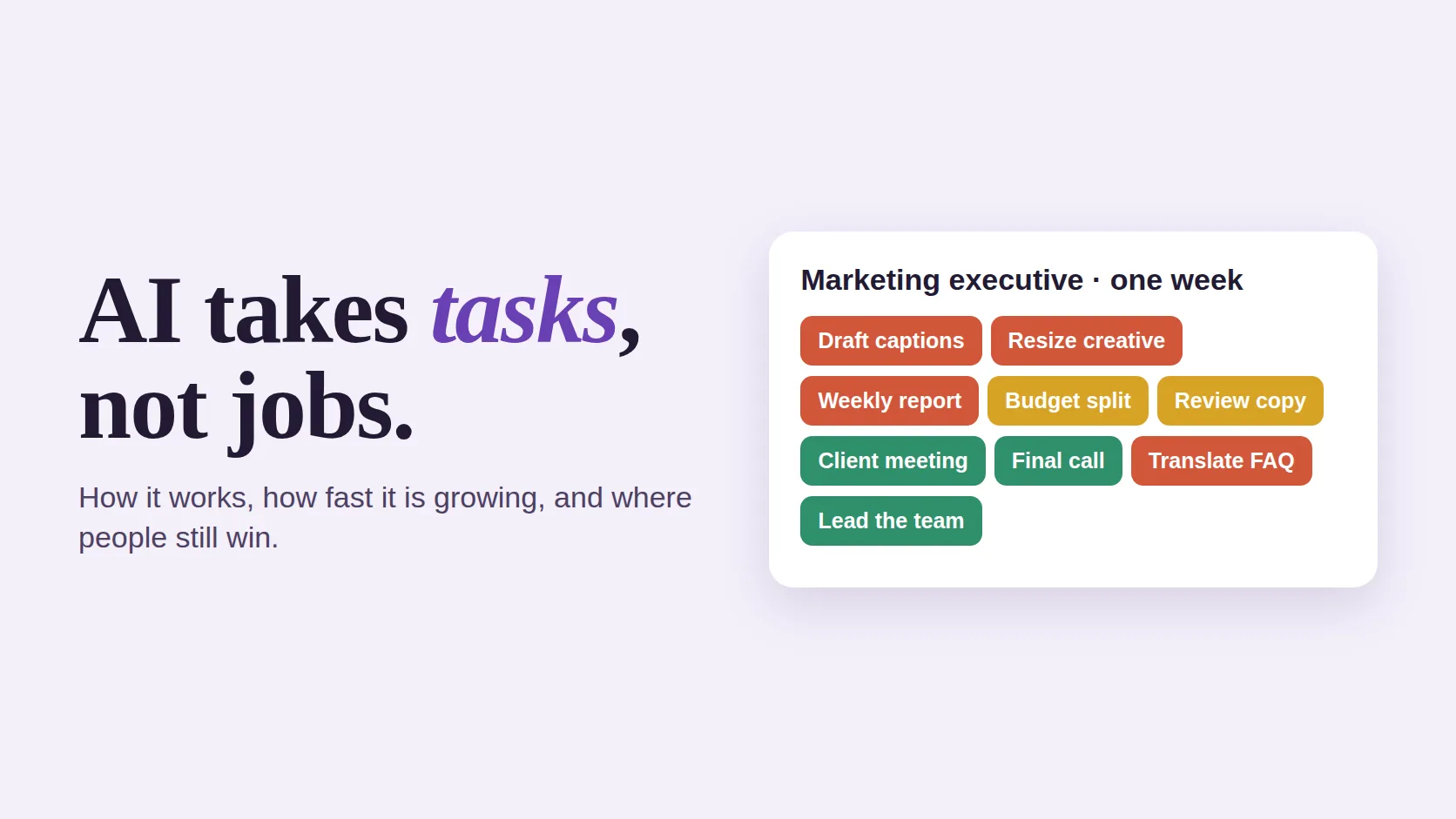
“Will AI replace marketers, accountants or designers?” assumes a job is one thing. It isn’t. A social media manager’s week might be forty tasks: writing captions, resizing images, replying to comments, reporting, arguing with a client about the brand voice, noticing that a competitor just launched something. AI is excellent at some of those, average at others and useless at a few.
The job disappears only when almost every task in it can be done well enough by software. Most jobs don’t get there. They get reshaped.
What does happen, often quietly, is that a team of five does the work of eight, or a business that would have hired a junior never posts the vacancy. That is the real risk to watch: not a dramatic firing, but a hire that never happens.
How AI is actually doing the work
It helps to understand the mechanics, because they explain both the power and the limits.
It predicts, very well
A large language model is trained on huge amounts of text, code and images to predict what comes next. At scale that becomes writing, reasoning, translating and coding.
It uses tools
Modern systems don’t just chat. They search the web, run code, read spreadsheets, click through software and call business systems. That is what turned chatbots into “agents”.
It works in loops
An agent plans, acts, checks the result and tries again. That loop is why AI can now finish multi-step tasks, like fixing a bug and running the tests, not just suggest an answer.
It still guesses
It does not know when it is wrong in the way a person does. It can state a false fact confidently. That is why human review, especially where money, health or law are involved, is not optional.
How fast it is growing
The speed is the part people underestimate. Here is the rough arc, as I have experienced it in marketing and web work.
- 2022
The chat moment. ChatGPT makes AI writing available to everyone. Drafts are generic but fast.
- 2023
Images and copilots. AI images go mainstream; coding assistants autocomplete lines.
- 2024
Multimodal and voice. Models read screenshots, PDFs and charts, and talk in real time. AI answers appear on top of Google.
- 2025
Agents arrive. Coding agents such as Claude Code and Codex edit whole projects. Businesses start deploying AI in customer support at scale.
- 2026
Agents at work. Long-running agents handle multi-hour tasks, run in the background and hand back finished work for review. The bottleneck shifts from doing to checking.
The World Economic Forum’s Future of Jobs Report 2025 surveyed employers worldwide and expected job disruption equal to 22% of today’s jobs by 2030: around 170 million roles created and 92 million displaced, a net gain, but with a large number of people needing to move between roles. [1] AI and big data topped the list of fastest-growing skills. The same report found that a large share of employers plan to reshape their business around AI, and many expect to reduce staff where tasks can be automated.
Where each task lands
This is the most useful way I have found to think about any role. Sort the tasks into three shelves.
AI does it
Repeatable, digital, easy to check
- First drafts of captions and product descriptions
- Resizing and reformatting creative
- Transcribing and summarising meetings
- Translating standard text between Arabic and English
- Routine reports from clean data
- Answering FAQ-style customer messages
AI drafts, a human decides
Needs judgement or accountability
- Campaign strategy and budget splits
- Code that goes to production
- Financial analysis and forecasts
- Legal, medical or HR communication
- Brand messaging for a new launch
- Hiring shortlists
Stays human
Trust, presence, responsibility
- Winning a client’s trust in a meeting
- Reading a room or a relationship
- Making the final call and owning the result
- Physical, on-site and hands-on work
- Knowing the local context no one wrote down
- Leading people through change
Notice the pattern. The top shelf is where entry-level work used to live. That is why the pressure lands hardest on juniors and on roles that are mostly production, and less on roles that are mostly judgement, relationships or physical presence.
How exposed is your role?
Tick the tasks that take up real time in your week. The mapper sorts them onto the three shelves. It runs in your browser and saves nothing.
This is a thinking aid, not a prediction. It counts tasks equally; weight them by hours in your head.
What this means for jobs in Oman
Oman has a young, fast-growing workforce and a national push, through Oman Vision 2040 and its digital economy programme, to build skills in technology and to increase Omanisation in the private sector. [2] AI cuts both ways here.
Pressure points
Entry-level content, translation, data entry, basic customer service and routine back-office roles, especially where the work is already fully digital. Businesses may hire fewer juniors for these tasks.
Openings
Bilingual people who can review and correct AI output in Arabic and English. Staff who can set up and supervise AI tools inside a business. Sales, service and trades that depend on trust and presence. Small teams that can now compete with big agencies.
Arabic is a real advantage. AI Arabic has improved a lot, but dialect, tone and cultural nuance still trip it up. A person who can make AI output sound genuinely Omani is doing work the tool cannot do alone.
A personal playbook for the next two years
Use it daily, on real work. Not a course, not a demo. Pick one task you do every week and do it with AI for a month. Skill with these tools comes from volume.
Move up the shelf. If most of your week sits on the top shelf, deliberately take on tasks from the middle: reviewing, deciding, explaining results to clients.
Become the checker. As AI produces more, the scarce skill is knowing whether the output is right. Deep knowledge of your field is worth more, not less.
Own a result, not a task. “I write captions” is exposed. “I grow qualified leads from Instagram” is a job AI helps you do.
Document what only you know. Local context, client history, what failed last Ramadan. That knowledge makes you the person who can direct the AI well.
For business owners: replace tasks, not people
The businesses I see doing well with AI don’t start by cutting staff. They remove the most boring hours from their team’s week and point those hours at sales, service and quality. A team that trusts the tools uses them; a team that fears them hides problems.
Start with one workflow, such as replying to WhatsApp enquiries or producing weekly reports. Measure the hours before and after. Keep a human checking anything sent to customers. Put the saved time somewhere visible, and tell your team where it went.
Questions people ask me
Is digital marketing a bad career choice now?
No, but the entry point has moved. Juniors now need to show they can use AI tools and still judge quality, strategy and results. Pure production skills are worth less on their own.
Which jobs are safest?
Roles built on physical presence, trust and accountability: healthcare, skilled trades, sales, leadership, teaching. Even these will change, but they are hard to automate end-to-end.
Should I learn to code?
Learn to direct and check AI that codes. Understanding what code does, how data flows and how to test it is more valuable than memorising syntax.
Sources
Checked September 25, 2026. The task shelves and mapper are my own framework for thinking, not a research model.
- World Economic Forum: The Future of Jobs Report 2025 — employer survey on job creation, displacement and skills to 2030.
- Oman Vision 2040 — national priorities including the digital economy and human capital.