


Build the campaign backwards from profit.
Choose an offer, stress-test the economics and give the team a campaign calendar that survives contact with real orders.
How much room does your sale leave?
Enter an illustrative order. Use amounts on the same tax basis. This simple calculation excludes fixed costs and future repeat purchases.
Other variable costs can include payment fees, packaging, delivery subsidy and an expected returns allowance. Update them if the offer changes.
With November approaching, it is easy to start a White Friday campaign by choosing a discount and commissioning a poster. Reverse that order. Decide what the sale must contribute to the business, then build an offer that can carry its advertising and fulfilment costs.
This is a planning framework for Oman retailers, not a forecast of local shopping demand. Your own stock position, repeat purchase history and delivery capacity are more useful than a generic promise that the season will bring record sales.
Calculate what one order leaves behind
Use revenue after the discount, on a consistent tax basis. Subtract product cost, payment costs, packaging, delivery subsidy and a realistic allowance for returns. What remains before advertising is the most you could spend to acquire that order while leaving zero contribution towards overhead and profit. Your actual target should leave room for both.
| Item | Normal order | 20% discount |
|---|---|---|
| Revenue | 50.000 | 40.000 |
| Product cost | 25.000 | 25.000 |
| Other variable costs | 5.000 | 5.000 |
| Contribution before ads | 20.000 | 10.000 |
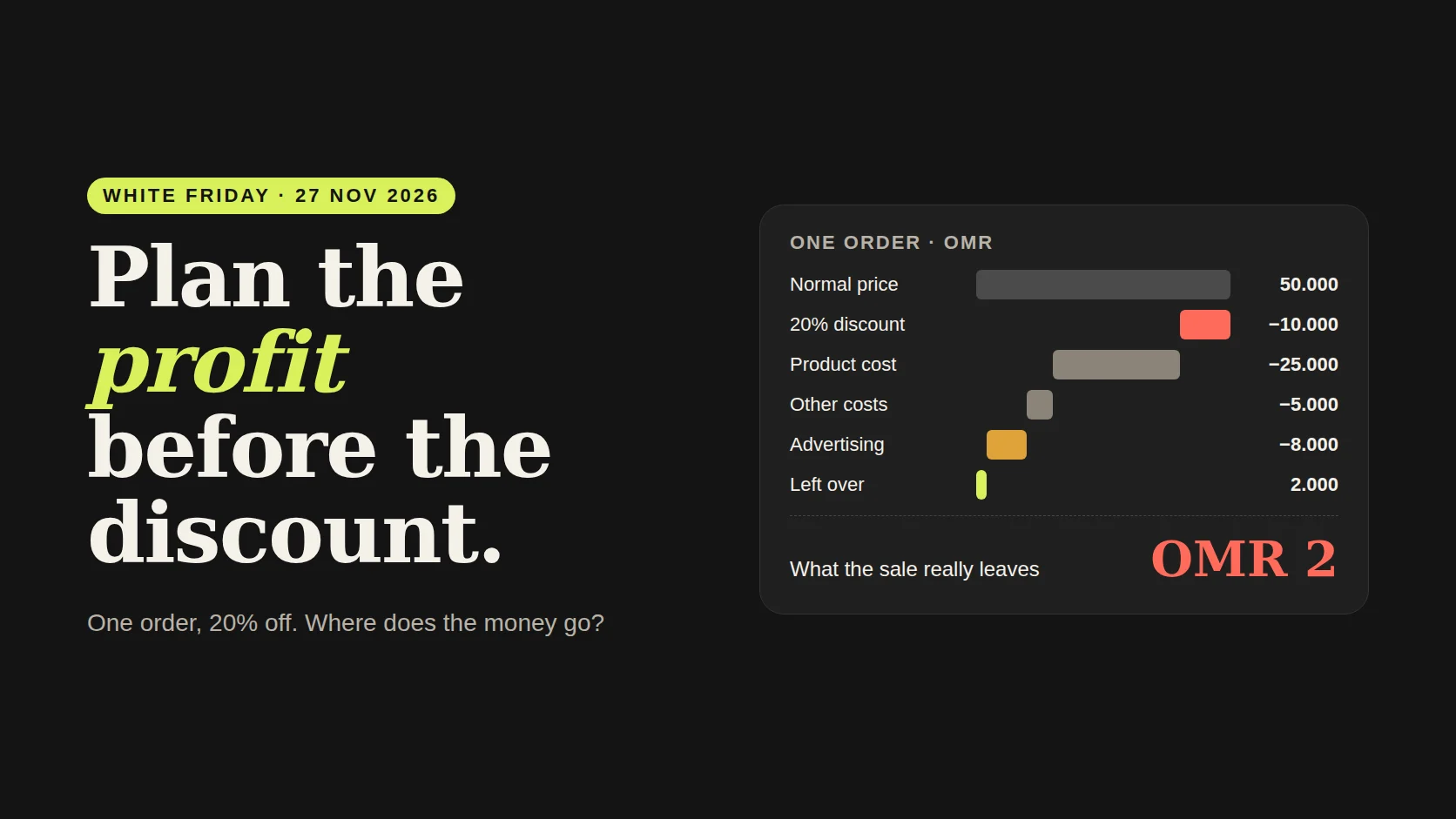
In this simplified example, a 20% price discount halves contribution before advertising. At OMR 8 acquisition cost, the sale order leaves OMR 2 before fixed costs. Its revenue-to-ad-spend ratio is 5, yet that does not automatically make it attractive. These figures are an example, not an Oman benchmark; payment and return costs may also change with the offer.
Choose the stock before the headline
Separate products you can replenish from limited stock and slow-moving lines. A blanket discount can subsidise items customers were already willing to buy at full price. Consider a selected bundle, a useful add-on or a minimum-order benefit, then calculate its economics just as carefully as a percentage reduction.
Check whether the bundle solves a real problem. A bathroom accessories set with clear dimensions and matching finishes can make choosing easier. A bundle padded with unwanted items may simply create confusion. Tell customers exactly what is included and what remains optional.
Use the remaining weeks well
- Now: choose the commercial objective, stock allocation and contribution target. Confirm the requirements applicable to the planned promotion before advertising it.
- Before launch: prepare product pages, accurate prices, delivery information, creative variations and staff replies in the languages your buyers use.
- Final checks: place a test order on a phone, test discount eligibility, inspect confirmation messages and check the out-of-stock experience.
- During the sale: review spending, stock, payment failures and fulfilment capacity together.
- Afterwards: reconcile fulfilled orders, cancellations, returns and actual contribution.
Give advertising a limit the business understands
Set a maximum acquisition cost from the contribution calculation and agree what happens when the campaign exceeds it. Avoid using an optimistic lifetime value to justify today's losses unless repeat purchase evidence supports the assumption. Review new and returning customers separately: buying back a loyal customer through an ad is not the same as acquiring a new buyer.
For Google Ads, do not assume a sale requires a month-long seasonality adjustment. Google says Smart Bidding already handles normal seasonal patterns; its seasonality adjustments are intended for major conversion-rate changes and work best for short events of one to seven days. Use them only when the campaign and expected change justify the setting.
Protect the promise after the click
Customers should see the same offer in the ad, product page, cart and staff reply. State genuine exclusions and realistic delivery expectations. If stock runs out, pause the affected promotion or offer an honest alternative. Scarcity messaging should describe actual availability.
Three offers. Three different jobs.
The right offer depends on the business problem. Clearing excess stock, attracting a first-time buyer and increasing basket size are different objectives. Choose one primary objective before asking the design team for a campaign headline. Otherwise every department will judge the sale against a different expectation.
Move specific stock
Useful when particular lines need attention. Protect full-price demand on other items and state the included products clearly.
Make a decision easier
Combine products people genuinely need together. Calculate the combined cost and make the contents easy to understand.
Reward a larger basket
A delivery benefit or useful add-on may fit a threshold. Include its real cost and check whether the customer values it.
For a homeware shop, a coordinated bathroom-accessory set may make more sense than discounting every item. For a service business, a seasonal booking package needs a capacity check before a media plan. Neither example is automatically better: compare contribution and operational effort using your own figures.
The four-week production board
Choose the audience, offer, stock allocation, economics and campaign owner. Confirm applicable promotion requirements.
Build the product page, short demonstrations, offer explanation and staff reply sheet.
Check checkout, mobile payments, product questions, delivery information and tracking.
Launch within capacity. Review orders, margin and service issues together, then adjust.
This is a suggested preparation sequence, not a claim about the exact sale dates your business should choose. Work backwards from your approved campaign window. If only two weeks remain, reduce the offer's scope rather than skipping checkout and stock checks. A smaller campaign that customers can complete is more useful than an ambitious campaign with an unreliable buying path.
The creative needs to answer four questions
Show what is included, why the product is useful, what the customer pays and how to buy. A price graphic alone answers only one of those questions. Make a short demonstration, a clear offer explanation and a practical FAQ before adding more variations of the same sale poster.
For Oman audiences, write Arabic and English versions around the actual buying question. Check product names, units, delivery areas and the next step with a fluent reviewer. Do not shrink two long paragraphs into one overcrowded image. The ad can carry the main promise while the landing page provides the detail needed to make a confident purchase.
The landing-page test
Give someone the ad and ask them to buy from a phone without your help. Watch where they hesitate. If they need to ask you about the price, delivery area or included items, that information belongs in the buying journey.
A daily report that connects media and operations
Use a short shared report with advertising spend, paid orders, fulfilled orders, cancellations, expected contribution and service issues. Decide who updates each number. Reported purchases are useful for campaign management, but fulfilled orders and final costs determine the business result.
Watch stock by promoted item rather than only total inventory. One sold-out hero product can make the whole advertisement misleading even when the warehouse is full of other products. Give the operations team a clear way to request an ad pause or creative update without waiting for the next marketing meeting.
Define the stop conditions in advance: contribution below the agreed floor, a broken checkout, repeated payment errors or delivery capacity beyond the team's promise. Do not respond to every disappointing day by increasing spend. Diagnose whether the problem is demand, the offer, the buying path or fulfilment.
What to learn after the campaign
Reconcile returns and cancellations before calling the sale a success. Separate new and returning customers where you have a reliable basis for doing so. Record which products earned contribution, which messages answered buying questions and which operational promises caused friction.
Then decide what to keep for normal trading. A clearer product page, better reply sheet or useful bundle can continue working after the promotion ends. That learning is one of the most valuable outputs of a seasonal campaign, even when the winning idea is smaller than the original plan.
Before the sale goes live
Is a bigger discount always more persuasive?
No. Relevance, product confidence, delivery reliability and a clear buying path all affect the decision. Test an offer you can afford rather than assuming the largest discount will produce the best business result.
Can I use the calculator as my profit forecast?
It is a simplified per-order contribution check. Add fixed costs, actual fee structures, taxes where relevant, returns and sales-volume assumptions to your own business forecast.
What if the campaign gets orders but loses money?
Investigate the offer and costs before scaling. An intentional acquisition investment needs evidence and an agreed budget; it should not emerge accidentally from a revenue-only report.
Build the November campaign around money retained and customers served well. For the wider allocation, use the Oman marketing budget guide before committing the rest of your quarter.
Platform source: Google Ads: about seasonality adjustments, checked 17 October 2026. The financial example and campaign plan are illustrative editorial guidance.