


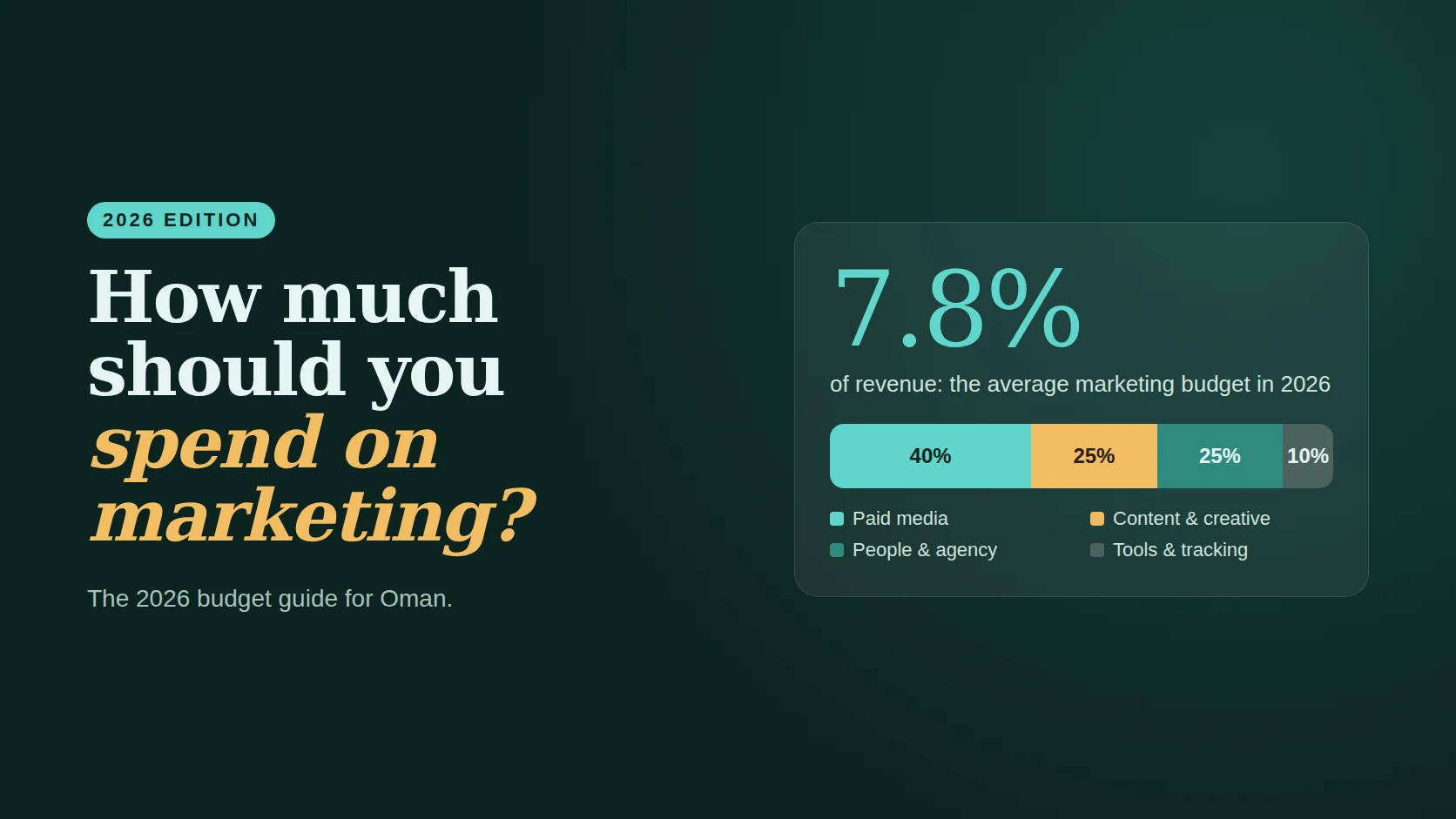
- Large companies spend about 7.8% of revenue on marketing. Smaller and newer businesses usually need a higher share to grow.
- Paid media is less than a third of a typical budget. The rest pays for the content, people and tools that make ads work.
- In Oman, demand is uneven. Spread the budget by month, weighted towards Ramadan, Eid, back to school and November.
- Decide the budget from revenue and goals, then prove it with cost per customer, not with likes or reach.
“How much should we spend on marketing?” is the question I hear most from business owners in Muscat, usually followed by “What are others spending?” The honest answer has three parts: a percentage of revenue that fits your stage, a split between ads and everything that makes ads work, and a calendar that matches how demand actually moves in Oman.
01What others spend
The most widely quoted benchmark is Gartner’s annual CMO Spend Survey. In 2026, marketing budgets averaged 7.8% of company revenue, up slightly from 7.7% in 2025.1 The survey covers around 400 marketing leaders, mostly at large companies in North America and Europe.
Two other findings are more useful than the headline. In 2025, half of CMOs reported budgets of 6% of revenue or less, so the average is pulled up by big spenders. And paid media took only 30.6% of the marketing budget.2 In 2026, CMOs also allocated 15.3% of their budgets to AI initiatives.1
is what 7.8% looks like for a business with OMR 500,000 in yearly revenue.
of a big company’s marketing budget is paid media. The rest is people, content, tools and research.
budgets two years running: marketers everywhere are being asked to do more with the same money.
Why not just copy 7.8%? Big companies spend on top of strong brands and existing customers. A café in Al Mouj or a clinic in Sohar has less brand memory to lean on, so the share it needs, at least for the first years, is usually higher.
02Budget by stage
These ranges are rules of thumb from my work with businesses in Oman, not industry benchmarks. Use them as a starting point, then adjust with your own results.
First one to two years, or entering a new market. You are buying awareness and first customers.
Product works and customers return. Fund acquisition and brand together.
Established brand with strong repeat business. Defend share, invest in retention.
Margins matter too. A business with 70% gross margin, such as software or services, can afford a higher share than a supermarket with 15% margin. If marketing costs more than the gross profit it brings in, the percentage is wrong, whatever the benchmark says.
03How to split it
The most common mistake I see is putting almost the whole budget into ads, then running those ads with weak creative, a slow website and no tracking. For a small or medium business in Oman, this split is a sensible starting point:
| Bucket | Share | What it pays for |
|---|---|---|
| Paid media | Google, Meta, Snapchat, TikTok and creator fees | |
| Content & creative | Photos, video, design, Arabic and English copy | |
| People & agency | Strategy, campaign management, community replies | |
| Tools & tracking | Website, analytics, CRM, WhatsApp tools, AI tools |
Small businesses usually put a larger share into paid media than Gartner’s 30.6%, because many of their people costs sit outside the marketing budget. But if ads are above about half of your spend, check whether the creative, landing page and tracking are strong enough to make that money work. See the Google Ads budget framework for channel-level planning.
04Spread it across the year
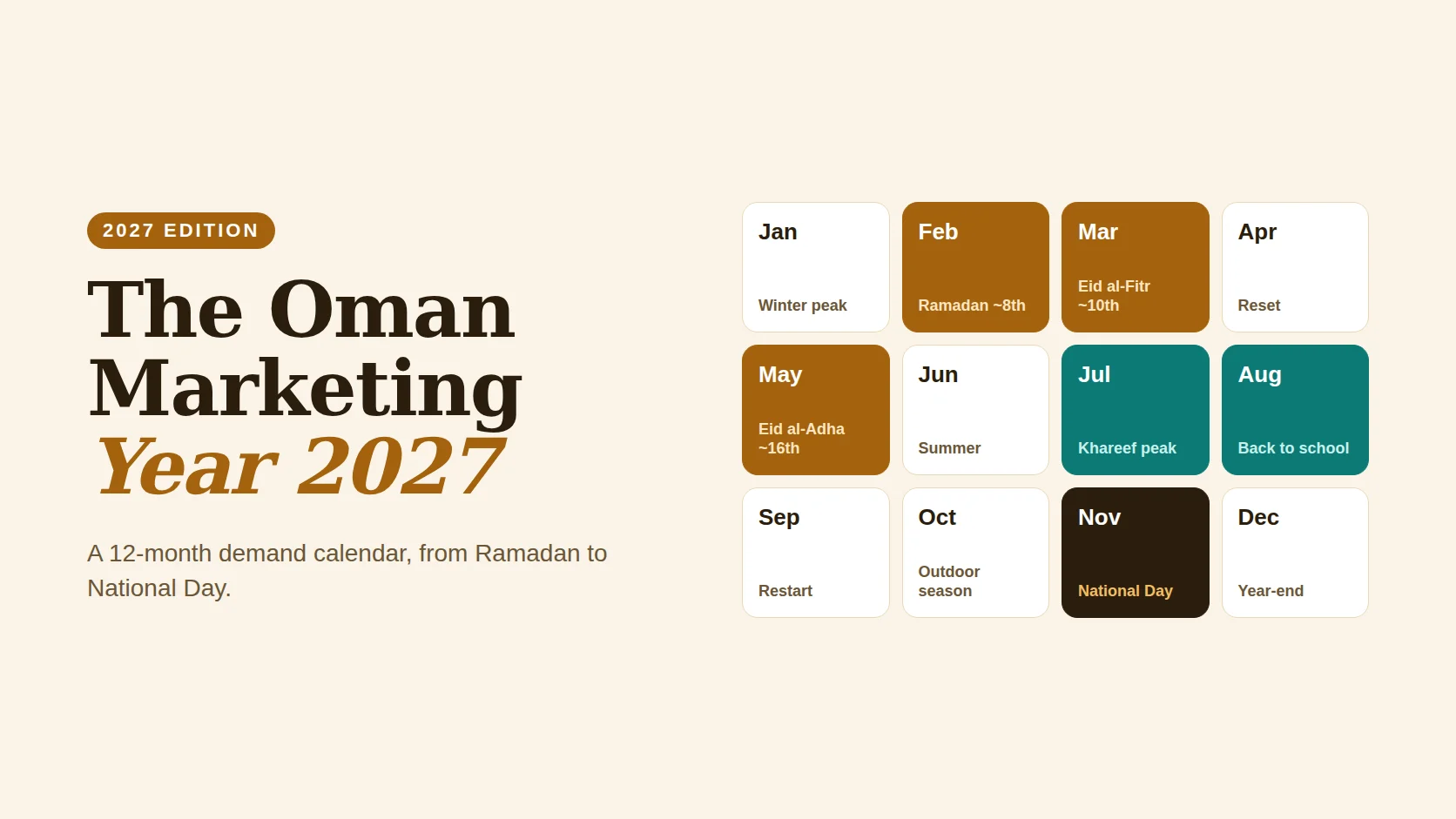
An equal monthly budget is easy to manage and almost always wrong in Oman. Demand clusters around Ramadan and Eid, back to school, Khareef and the November peak, and drops in the summer heat. Spending evenly means overspending in quiet months and running out of money when customers are actually buying.
A better approach is a small always-on base, usually 40–60% of the budget, plus peak pushes timed to your sector’s busy months. The Oman Marketing Year 2027 shows when those peaks fall next year.
What should your 2027 budget be?
Enter your expected annual revenue, your stage and your sector. The calculator suggests a budget, a split and a month-by-month spread for Oman.
Runs in your browser; nothing is saved. Percentages, split and seasonal weights are rules of thumb from campaign experience in Oman, not measured benchmarks.
05Prove it is working
A budget is a hypothesis. Three numbers tell you whether it is right:
What does a new customer cost?
Total marketing spend in a period divided by new customers in that period. Compare it with what a customer is worth over a year.
Revenue per OMR spent
New revenue divided by marketing spend. Track the trend month by month rather than chasing a single target.
Are more people searching for you?
Branded search shows whether spending builds memory, not just clicks. See do people search for your name?
Can you see it at all?
Without conversion tracking, you are guessing. Start with conversion tracking for Oman businesses.
Common questions
What percentage of revenue should a business spend on marketing?
Gartner’s 2026 CMO Spend Survey found an average of 7.8% of revenue, mostly among large companies. Smaller and newer businesses often need more: around 12–20% at launch, 8–12% while growing and 5–8% once established, as a rule of thumb.
How should I split my marketing budget?
A sensible starting split for small and medium businesses is about 40% paid media, 25% content and creative, 25% people or agency support and 10% tools and tracking. Adjust it once you see what drives results.
Should I spend the same amount every month?
Rarely. In Oman, demand peaks around Ramadan and Eid, back to school, Khareef and November. Keep an always-on base and add extra budget before and during your sector’s peak months.
How do I know if my marketing budget is too low?
If your cost per customer is healthy and you still have customers you cannot reach, the budget is too low. If cost per customer keeps rising as you spend more, fix creative, targeting or your website before adding money.
Method & sources
Checked October 15, 2026. Benchmarks are from Gartner’s annual CMO Spend Survey; stage ranges, the budget split and seasonal weights are my rules of thumb and are labelled as such.
- Gartner, “2026 CMO Spend Survey Finds CMOs Allocate 15.3% of Marketing Budgets to AI”, 11 May 2026. gartner.com
- Campaign, “Marketing budgets hold at 7.7% in 2025: Gartner CMO survey” (half of CMOs at 6% or less; paid media 30.6% of budgets). campaignlive.com