





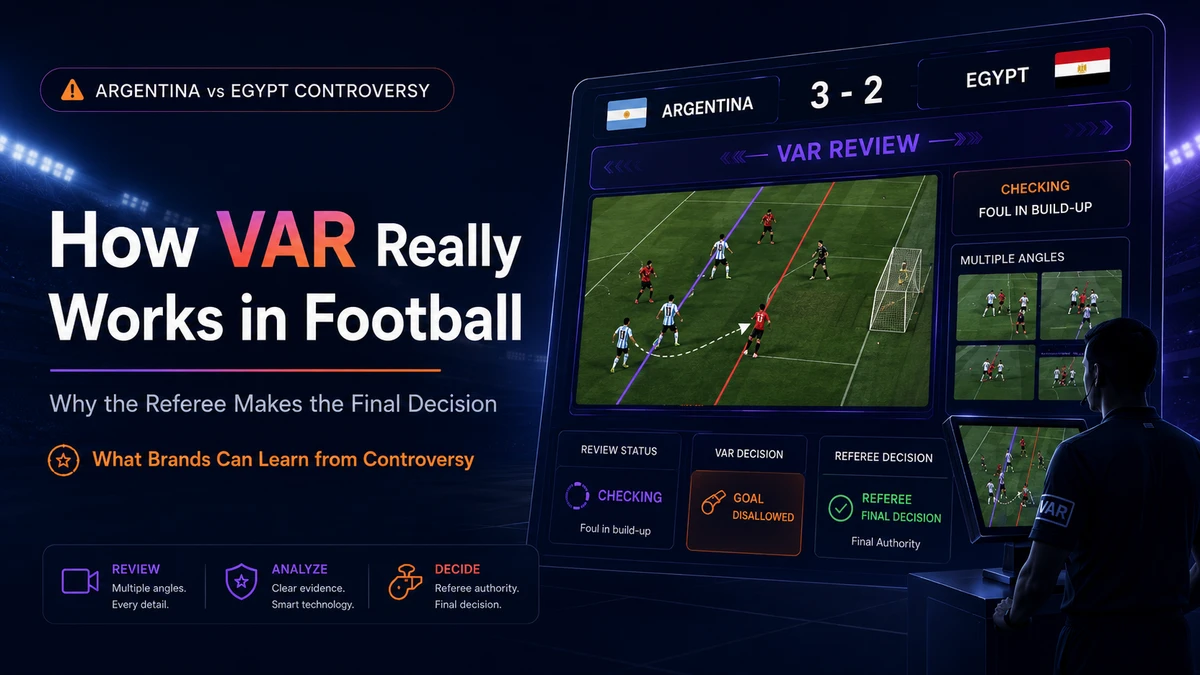
After a controversial match, social media often moves faster than the rulebook. Fans clip one angle, pick a side, and decide the referee was the problem. That reaction is understandable, but it is not always accurate. VAR exists to help the referee correct certain clear errors, not to replace the referee's authority.
This post uses a simple football example, including the kind of Argentina-related debate that spreads online after big matches, to explain what VAR can do, what it cannot do, and why the final decision still belongs to the referee. That also makes it a useful lesson for brands that have to respond quickly when misinformation starts trending.
Useful rule: VAR supports the referee, but it does not own the final decision. If fans want to understand the call, they need the protocol, not just the clip.
The VAR process in plain English
The IFAB protocol is straightforward once you strip away the noise. The referee makes an initial decision on the field. The VAR checks the relevant footage. If there is a clear and obvious error or a serious missed incident in a reviewable category, the referee can be asked to review the play. The final call is always the referee's.
| Step | What happens | Why it matters |
|---|---|---|
| 1. Referee decision | The referee must make an initial decision as if VAR does not exist. | This keeps the game moving and avoids weak no-decisions. |
| 2. VAR check | The VAR checks goals, penalties, direct red cards, mistaken identity, and in some competitions certain corner-kick decisions. | Only specific incidents are reviewable. |
| 3. Review or recommendation | If the footage shows a clear and obvious error, the VAR recommends a review. | The referee still decides whether to go to the monitor or accept the information. |
| 4. Final decision | The referee makes the final call, either from the on-field review or from VAR information. | The protocol does not hand final authority to the video room. |
| 5. Restart | Once play restarts, review options become very limited. | Fans often miss this and assume any later clip can still change the call. |
What VAR can actually review
The IFAB protocol limits VAR to a small number of match-changing decisions. That is why a fan may feel a foul or handball was missed while the system does nothing. If the incident is outside the reviewable categories, the VAR cannot just step in because the crowd is angry.
| Reviewable area | Examples | Common fan misunderstanding |
|---|---|---|
| Goal / no goal | Offside, foul, handball, ball out of play | People assume every close call should be replayed |
| Penalty / no penalty | Was the foul inside the box? Was it correctly awarded? | Fans often confuse contact with a guaranteed penalty |
| Direct red cards | Serious foul play, violent conduct, clear red-card mistakes | People think any yellow-card debate is automatically reviewable |
| Mistaken identity | Wrong player booked or sent off | Many fans do not realize the identity alone can be corrected |
Why fans think the system is biased
A controversial match can make every replay feel like proof of a conspiracy. In reality, a few things usually drive the outrage: one camera angle makes the contact look stronger, a favorite team gets the bad side of the call, the clip spreads without the full sequence, and social media turns emotion into certainty. That does not mean the debate is fake. It means the context matters.
- One angle does not tell the entire story.
- Emotion from a close match makes every decision feel bigger.
- Clipped clips remove the lead-up and the restart rules.
- Fans often want a clean hero or villain instead of a protocol.
What this means for marketers
This is the same pattern brands face during any fast-moving controversy. The loudest post wins attention first, but the most trusted explanation wins over time. If your business ever needs to respond to a rumor, a broken claim, or a public misunderstanding, the right move is to publish facts quickly, keep the tone calm, and link to the source rather than arguing with the timeline.
Start with the rule or the process, not with outrage.
One good article beats five emotional social posts.
Make the reader one click away from the official rule.
When the topic is heated, trust grows faster than hot takes.
A simple reply framework for brands
- State what happened in one sentence.
- Explain the rule or policy that applies.
- Link the official source or governing body.
- Keep the tone calm, specific, and human.
- Only add opinion after the facts are clear.
FAQ
Can the VAR overrule the referee directly?
No. The VAR can recommend a review, but the referee keeps the final decision.
Why did the referee not review every close call?
Because only certain incidents are reviewable, and not every mistake or complaint fits the protocol.
Does VAR always use an on-field review?
No. Some decisions are handled by information alone, but subjective calls often use a monitor review.
What can brands learn from this?
When a topic is controversial, trust comes from clarity, sources, and calm explanation, not louder opinions.
Official references
I would keep these official docs open while explaining a controversial match or building a fact-first response: