

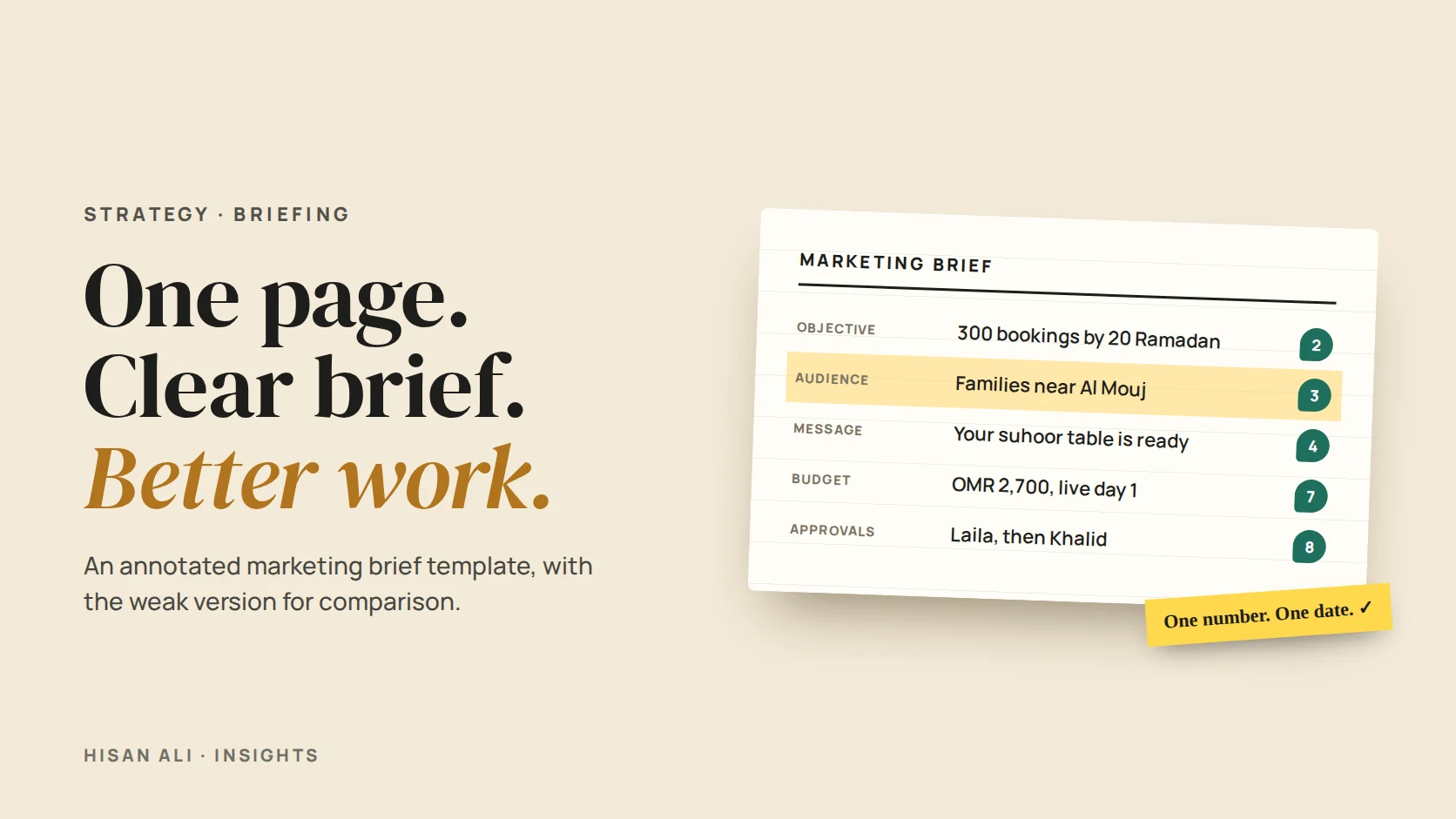
- One page is enough. If it needs five pages, the thinking isn’t finished yet.
- One objective, one audience, one message. Every extra one weakens the others.
- Write what success looks like as a number and a date, before work starts.
- Include the “must nots”: budget, deadline, brand rules and approvals. Surprises later cost the most.
Every business in Oman has a version of this story. You ask a designer for “a modern Instagram post for our offer”. You get something modern. It is not what you wanted. Two rounds of revisions later, everyone is frustrated and the offer has already started.
The problem was never the designer. It was the eleven-word brief. A good brief takes 30 minutes to write and saves days of back and forth. It also forces you to decide what you actually want, which is often the hardest part.
01Why most briefs fail
“Make it pop”
Words like modern, premium and eye-catching mean something different to every person. Show references instead.
Awareness, leads and sales
A single campaign that tries to do everything does nothing well. Pick the one result that matters most.
“Everyone in Oman”
A 24-year-old in Seeb and a 50-year-old business owner in Sohar need different words, pictures and channels.
The surprise approver
The work is nearly done when the owner sees it for the first time and changes the direction. Name approvers on day one.
02The eight sections, explained
You can copy the blank version above. Here is what each section is for, and the question it should answer.
| Section | The question it answers | Good sign |
|---|---|---|
| Background | Why are we doing this now? | Two or three sentences, including what changed |
| Objective | What single result do we want? | A number and a date |
| Audience | Who exactly, and what do they believe today? | A person you could describe, not a demographic |
| Key message | What one thing should they remember? | Fits in one sentence |
| Proof | Why should they believe it? | Facts, reviews, guarantees |
| Deliverables | What exactly do we need, in which sizes and languages? | A list someone could tick off |
| Budget & timing | What are the limits? | Real figures and the launch date |
| Approvals | Who says yes, and by when? | Names, not departments |
03Red flags before you send it
04Handing it over well
Don’t just email the brief. Send it, then talk through it for 15 minutes. Ask the person receiving it to explain it back to you in their own words. If their version is different from yours, the brief needs another edit, and you just found out for free.
Agree on the next checkpoint: usually a rough direction or sketch within a few days, before anyone spends time on polish. It is much cheaper to change direction on a sketch than on a finished video.
“The brief is the cheapest place to fix a campaign. Every stage after it costs more.”
Questions
How long should a marketing brief be?
One page for most campaigns, posts and small projects. Large projects such as a website or rebrand can have a longer appendix, but the core brief should still fit on one page.
Who should write the brief, me or the agency?
The business should write the first version, because only you know the goal, the budget and the customer. A good agency will then challenge it and help sharpen it.
What if I don’t know my budget yet?
Give a range. Without one, suppliers either over-design something you can’t afford or under-design to be safe.
Does a brief need to be formal?
No. A shared document, a filled template or even a clear WhatsApp message with the eight sections works. What matters is that the decisions are written down.
Method
Written October 2, 2026. The template and red flags are based on briefing agencies, designers and media teams for businesses in Oman and the GCC. The example brief is illustrative; the business is fictional.