



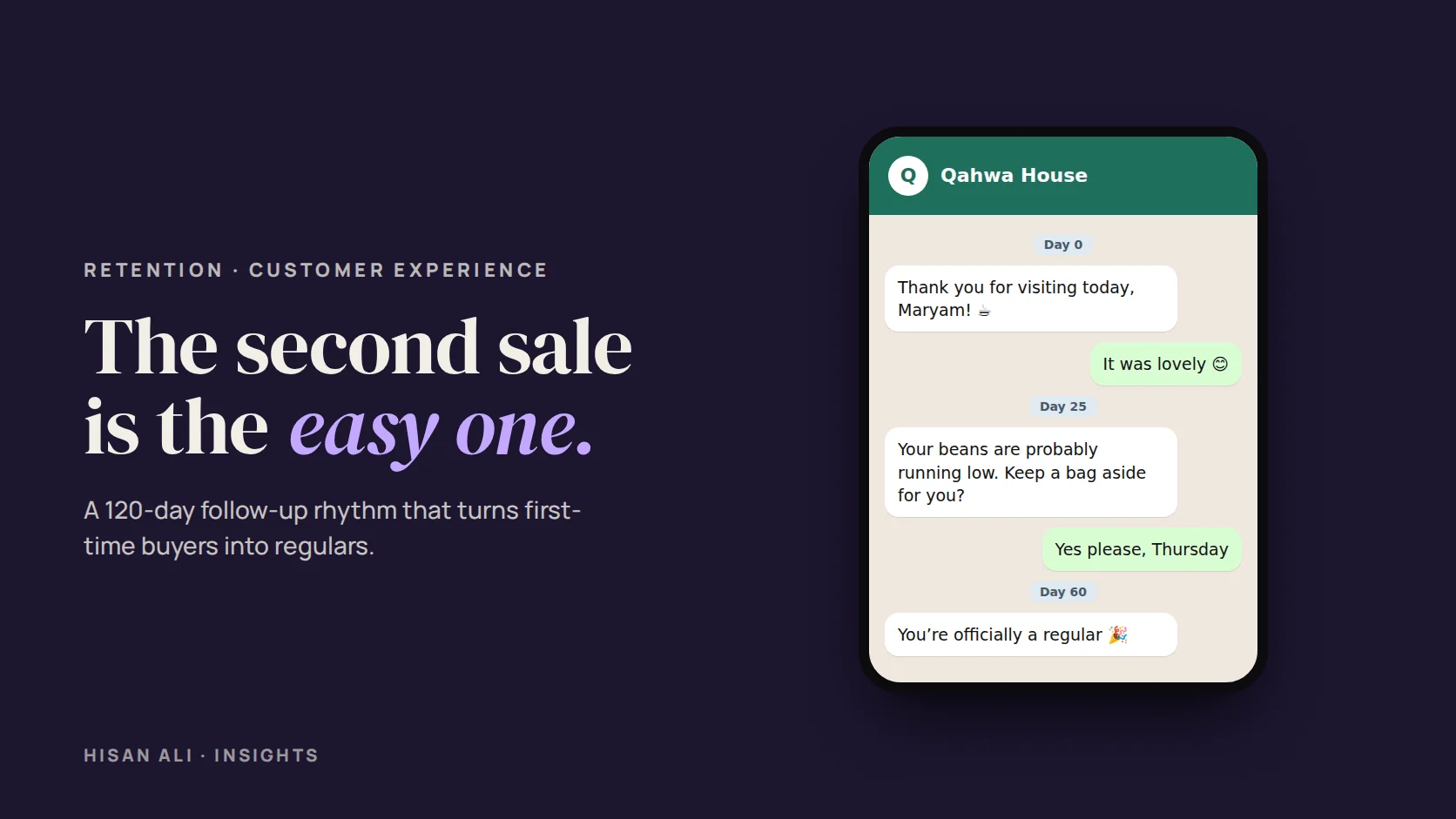
- The days after the first purchase matter most. That is when people decide if you were a one-off.
- Time messages to the customer’s cycle, not your calendar: when the coffee beans run out, when the next check-up is due.
- Help before you sell. A useful message earns the right to send an offer later.
- Get consent and keep it light. A few relevant messages beat a weekly broadcast nobody asked for.
A customer who has bought from you once already knows where you are, how you work and whether they liked it. Persuading them to come back is usually much easier and cheaper than convincing a stranger. Yet most small businesses in Oman do nothing after the receipt is printed.
The fix is not a complicated loyalty app. It is a handful of well-timed, genuinely useful messages, sent with permission, through the channel your customers already use. In Oman, that is usually WhatsApp.
01Why retention is the cheaper growth
The hard part is done
They have already chosen you over the alternatives once. You don’t need to introduce yourself again.
No ad auction
A message to an existing customer costs a fraction of what it takes to reach a new one with ads.
Regulars bring friends
In a close-knit market like Oman, a happy repeat customer is your most believable advert.
Predictable revenue
Repeat business evens out the quiet months and makes planning, stock and staffing easier.
02Choosing a loyalty approach
You don’t need a loyalty programme to retain customers; the messages above do most of the work. But if you want one, pick the simplest type that suits how often people buy.
| Type | Works best for | Watch out for |
|---|---|---|
| Stamp card (digital or paper) | Frequent, low-price visits: cafés, car washes, laundries | Paper cards get lost; digital ones need a simple scan |
| Points | Shops with varied basket sizes | Too complicated if customers can’t tell what points are worth |
| VIP tier or members’ list | Higher-value services: salons, clinics, gyms | Rewards must feel exclusive, not just a discount |
| Referral reward | Services people talk about: tutoring, clinics, home services | Reward both sides, and keep it honest |
| Subscription or bundle | Repeat products: coffee beans, water, pet food, cleaning | Make cancelling easy; trust is the point |
03What to watch
04Rules for messaging in Oman
Ask permission at the point of sale (“Can we send you care tips and occasional offers on WhatsApp?”) and record the answer. Oman’s Personal Data Protection Law (Royal Decree 6/2022) sets rules for processing personal data, and WhatsApp’s own Business policies require opt-in for marketing messages. Make it easy to stop: tell people they can reply “stop” and honour it.
Respect timing. Avoid messages during prayer times and late at night, adjust to the Ramadan schedule, and keep promotions away from moments of mourning or national significance. Write in the language the customer used with you.
“People don’t mind hearing from a business. They mind hearing from a business that doesn’t know them.”
Questions
How often should I message past customers?
Follow the customer’s natural cycle rather than a fixed calendar. For most businesses that means a few messages in the first months and then roughly once a month at most, only when you have something useful or relevant to say.
Should I use WhatsApp, SMS or email in Oman?
WhatsApp is usually the most read and the most natural for local customers. Email works for receipts and longer content; SMS is useful for short reminders such as appointments. Always use the channel the customer agreed to.
Do I need consent to send offers on WhatsApp?
Yes. Ask clearly, record the answer and make it easy to opt out. WhatsApp’s Business policies require opt-in for marketing messages, and Oman’s data protection law applies to customer data.
Is a discount the best way to win customers back?
Not always. A personal check-in, a new product they would like or a small extra often works as well and protects your margins. Save discounts for customers who have gone quiet for a long time.
Method & sources
Written October 2, 2026. The message timings are starting points based on work with service and retail businesses in Oman and the GCC; adjust them to your customers’ buying cycle. Example businesses and names are fictional.
- WhatsApp Business Policy and opt-in guidance. business.whatsapp.com/policy
- Sultanate of Oman, Personal Data Protection Law, Royal Decree 6/2022. Ministry of Transport, Communications and Information Technology. mtcit.gov.om