



Your campaign can survive a platform change.
A practical migration room: know what changes, protect your best landing pages and decide what evidence would justify more spend.
How ready is your account to migrate?
Select the statements you can prove today. This is a preparation checklist, not a prediction of advertising performance.
Your Search campaign may be heading for a platform change even if your business strategy has not changed. For an Oman advertiser, the useful question is not whether AI sounds promising. It is whether the transition will keep sending the right customers to the right pages, at a cost the business can support.
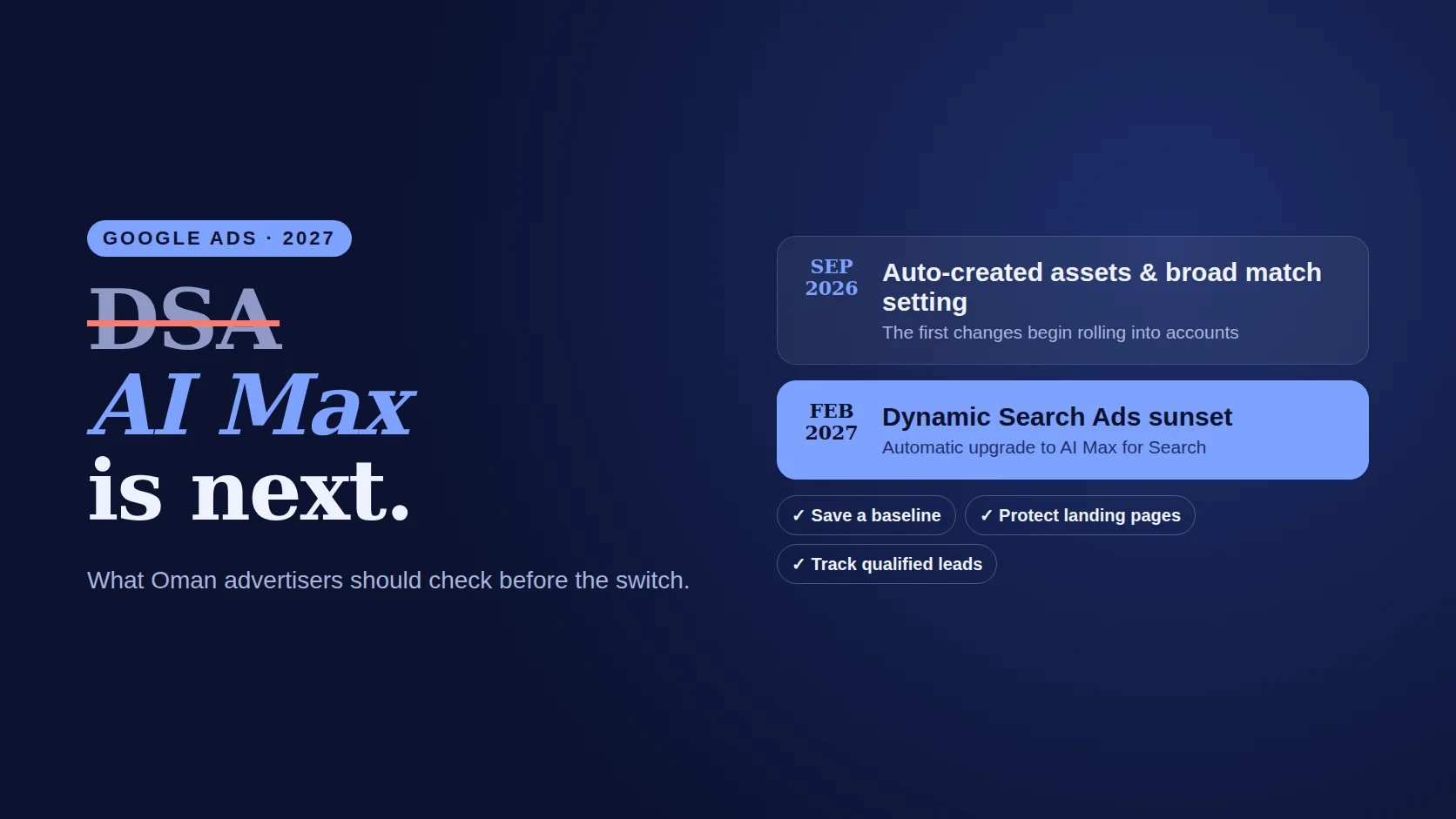
Timeline checked on 17 October 2026: Google's June 11 update moved the start of the Dynamic Search Ads sunset and automatic upgrade to February 2027. Automatically Created Assets and campaign-level broad match retained a September 2026 start. These are different timelines; check your account notices.
First, identify which change affects you
Google's announcement still contains older September wording below its dated update. Read the update first. Do not assume every Search campaign is affected, or that every account has already migrated. Ask whoever manages the account to identify campaigns using dynamic ad groups, Automatically Created Assets or the campaign-level broad match setting. Save the current settings and the account's own notification.
This is a migration checklist, not another introduction to AI Max. If you need the wider context, start with the AI Max guide. The following recommendations are an operating plan for a small business, not a promise of improved performance.
Build a baseline before changing anything
Export a representative period that includes normal trading days. Record spend, leads, qualified leads, sales, revenue where available, and the time it usually takes a lead to become a customer. Keep Arabic and English enquiries visible in your review. A cheap form submission from outside your service area is not equivalent to a qualified local enquiry.
For a Muscat interiors business, for example, a useful lead might require a serviceable location, an identifiable project and a realistic buying window. Agree that definition with the sales team before judging a campaign. This example is illustrative; choose criteria that fit your own sales process.
Audit the pages automation can use
List the pages you want customers to land on and the pages that should never receive paid traffic. Check outdated promotions, discontinued products, recruitment pages and services you no longer provide. Make sure Arabic and English pages describe the same current offer, and that the WhatsApp button works from a phone.
- Write down approved destinations and exclusions.
- Check service areas, availability and delivery promises.
- Remove unsupported claims from the source page itself.
- Confirm conversion events are recorded once and represent meaningful actions.
Separate the migration from the budget decision
Changing the bidding target, creative, website and daily budget at the same time makes a result difficult to explain. Plan a controlled transition with a recorded change date and a named owner. Where an experiment is available and practical, agree its success criteria before starting. Low-volume accounts may need more time to produce useful evidence.
Review search intent and landing destinations alongside cost. If lead volume rises while sales quality falls, investigate the queries, geography, page promise and conversion definition before increasing spend. A platform conversion count cannot resolve those questions on its own.
A working handover checklist
A Muscat showroom: one change, three possible outcomes
Imagine a showroom advertising kitchen fittings and bathroom accessories. It serves customers in a defined delivery area and handles most quotes through WhatsApp. The account counts a WhatsApp click as a conversion. That is convenient for reporting, but it does not tell the owner whether the visitor asked for a price, requested a quote or ordered anything.
Before the transition, the team reviews a sample of enquiries and agrees on a qualified-lead definition. The salesperson records the product category, serviceable location and buying stage without collecting unnecessary information. The marketer then compares the advertising report with those business outcomes. This is an illustrative process, not a client case study or a claimed result.
More enquiries, same quality
Investigate whether the additional qualified enquiries are arriving at an acceptable cost. Check the sales lag before claiming a revenue improvement.
More clicks, fewer useful leads
Check destination pages, customer intent and the conversion definition. A rise in reported conversions can hide a decline in commercial value.
Less volume, better business
Look at qualified leads and completed sales. Lower volume can still be acceptable if the business receives fewer unsuitable enquiries and stronger contribution.
The migration file your agency should hand over
A useful handover is small enough to review but detailed enough to explain a change. Ask for six items: the affected-campaign list, current settings, approved destinations, conversion definitions, the comparison period and the review owner. A screenshot saying “AI Max enabled” is not a handover.
Campaign, affected feature, account notice and proposed action.
Where traffic may go and which claims the business can support.
Spend, qualified enquiries, sales lag and known seasonal changes.
Keep, investigate or adjust—with a reason and a review date.
For a bilingual account, record which language and page version each campaign serves. Do not use language as a substitute for geography. An English enquiry may come from a local resident, and an Arabic query does not guarantee the customer is within your delivery area. Confirm both the customer's need and the location your business can serve.
What to watch after the change
Use a review rhythm that fits your conversion volume and sales cycle. During the early checks, look for clear operational failures: broken pages, an incorrect offer, a tracking event firing repeatedly or a sudden concentration of irrelevant enquiries. These problems do not require weeks of statistical analysis before you investigate them.
Performance comparisons need more care. Avoid comparing a quiet week with a promotional weekend, or treating leads that have not had time to close as lost sales. Record changes in stock, opening hours, prices and sales-team capacity alongside the campaign changes. They can explain a result that advertising alone cannot.
The question to ask in the review meeting
“Which customer actions became more valuable after the change, and what evidence connects that improvement to this campaign?”
If the answer is only impressions, clicks or a platform score, the review is unfinished.
Questions worth asking before you switch
Should I increase budget when I migrate?
Not automatically. Keep the migration and the budget decision separate where practical. A larger budget needs evidence that the business can acquire and serve additional customers at an acceptable cost.
What if I only receive a few leads each month?
Use a longer representative window and inspect individual lead quality. Avoid declaring a winner from a tiny sample. You can still check page accuracy, tracking and service-area relevance immediately.
Does an upgrade mean the agency can stop reviewing the account?
No. Automation changes the work. Someone still needs to maintain source pages, interpret enquiries, review the account's controls and connect reported results to business outcomes.
Prepare while you have time to inspect the details. The best outcome is a documented transition whose business impact you can explain, rather than a surprise change discovered in a monthly report.
Primary source: Google's DSA-to-AI Max announcement and June 11 timeline correction. Checked 17 October 2026. The workflow and Oman examples above are editorial recommendations.